- Home
-
-

Smart Circuit Breaker vs Traditional Breaker
Views: 0 Author: Site Editor Publish Time: 2026-10-08 Origin: Site


A smart circuit breaker and a traditional breaker should not be compared as though one automatically makes the other obsolete. Both must first be suitable for the electrical circuit they protect. The useful difference is operational: a conventional breaker is principally selected for protective duty and manual isolation, while a 2P Smart MCB may add connected status, remote commands, schedules, and system integration. For a buyer or panel designer, the right question is not “which is better?” but “which functions are required, and can they be introduced without weakening the protection and operating discipline of the circuit?”Key Takeaways
Protection characteristics, voltage, current, breaking capacity, pole arrangement, and coordination come before app features.
A smart breaker adds value when a team needs governed visibility or control at a particular circuit.
A traditional MCB can be the appropriate choice when local protection and manual operation are all that the application requires.
Remote control must have clear permissions, verification steps, and a safe loss-of-communication plan.
The shared foundation: protection is not optional
Both device types are used in low-voltage distribution, but neither can be chosen by category name alone. A designer needs to establish the circuit’s rated conditions, available fault level, conductor arrangement, load behavior, required trip curve, installation environment, and the governing regulations. The presence of a radio, app, or communications terminal does not correct a mismatch in current rating or fault duty. Nor does a conventional label prove that a device fits every panel.
For example, Long Road Electric lists its LRM2-63 2P miniature circuit breaker for 230/400V AC distribution, with 1A to 63A ratings and simultaneous switching of line and neutral described on the product page. Those stated details illustrate the type of information that must be checked for a conventional 2-pole option. The final selection still depends on the actual system and product documentation.
What makes a 2P Smart MCB operationally different
A 2P Smart MCB adds an electronics layer that can communicate operating information and accept an approved command. The exact functions vary by model. The supplied Long Road Electric 2P ZigBee model is described as supporting remote opening and closing, local mode selection, timed operation, and multiple communications options. This means it can be considered as a managed node in a building or industrial distribution scheme rather than only a local manual component.
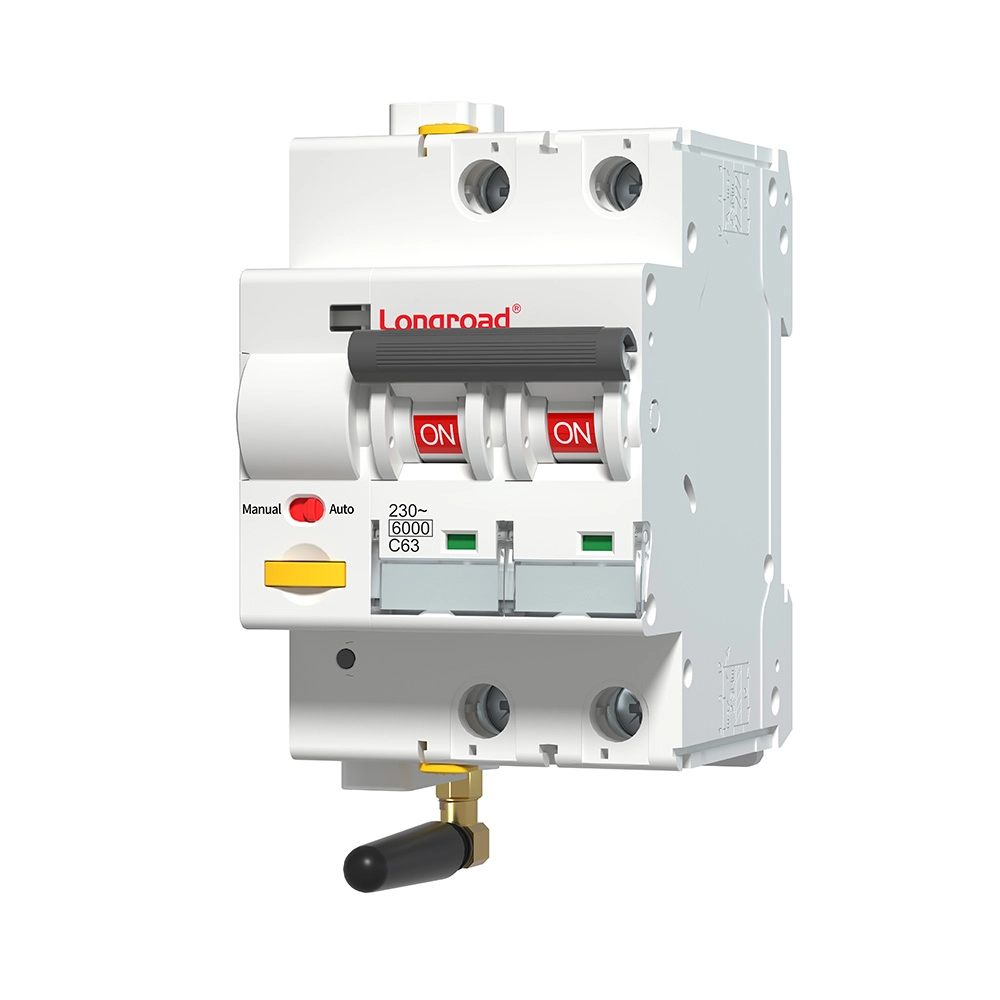
The difference is therefore a workflow difference. A conventional MCB may protect and be operated at the panel. A smart model can potentially report status to an authorized operator, participate in a scheduled control rule, or provide a controlled remote switching point. It should not be assumed to provide every possible function, including certified metering, universal platform compatibility, or safe automatic restoration for every load. Verify the exact function and its limits model by model.
Smart breaker vs traditional breaker: a fair comparison
Selection criterion
Traditional 2P MCB
2P Smart MCB
Primary purpose
Protect an appropriately designed circuit and provide local switching/isolation functions.
Provide appropriate circuit protection while adding specified connected management functions.
Normal operating interface
Local handle and panel procedures.
Local handle plus the supported app, gateway, BMS, or control interface.
Status visibility
Usually determined by physical inspection or associated panel equipment.
May be available through the model’s communications and configured platform.
Scheduling
Normally implemented with separate controls where required.
May be a listed feature, subject to configuration and operational approval.
System dependency
Primarily electrical and mechanical.
Electrical and mechanical, plus communications, platform access, and control governance.
Best fit
Circuits needing straightforward, local protective operation.
Circuits with a verified reason for monitored or remotely managed operation.
This is a decision table, not a hierarchy. A conventional device is often the lower-complexity option where there is no credible need for circuit-level connectivity. A smart device can justify its additional design effort when it supports a clear action: managing occupancy schedules, investigating an out-of-hours state, supporting a distributed facility team, or connecting a defined branch to a wider automation plan.
Where smart functions provide a real advantage
Remote observation and response. For geographically distributed properties or cabinets that are not continuously staffed, a status signal can help operators decide whether a visit is needed. A remote command should be issued only under a documented procedure that considers the connected load and people who may be working nearby.
Scheduled control for non-critical loads. Where the use pattern is predictable, an approved time schedule may help prevent unnecessary operation. This is not suitable for every circuit. Loads serving life safety, critical process equipment, refrigeration, security, medical functions, or essential IT require a specific risk assessment and may need different controls or no remote schedule at all.
Integration. The ability to work with a gateway, RS485 network, dry contact, or wireless protocol may simplify a wider control architecture. Integration should be proved in the target panel: verify the network path, loss-of-communication behavior, naming convention, access control, and alarm escalation before relying on the function.
Where a traditional breaker remains the better fit
A traditional breaker is often the right choice when the circuit does not require data, scheduling, or remote switching. It can reduce architecture complexity, avoids a communications dependency for normal operation, and keeps the maintenance conversation focused on the electrical system. This is especially sensible for simple branch circuits with clear local access and no reason to change their state remotely.
It is also the safer choice where the team cannot govern remote access or cannot establish what the controlled circuit does. Adding connectivity to an unclear circuit label, an undocumented load, or an unmanaged property portfolio creates an operational problem rather than solving one. Improve documentation and ownership first.
Questions to ask before upgrading
Start with the circuit, not the feature list. What must the device protect? Why is two-pole operation required? Is the load safe to switch remotely? What exact information is useful? Who can issue a command, and how is it verified? What happens when the gateway or network is down? Can local personnel override the control logic? These questions reveal whether a smart device has a useful, bounded role.
For an application that needs a connected distribution point, the 2P Smart MCB ZigBee product page is a sensible starting point for model-specific discussion. Long Road Electric lists 10A–63A options, Type C/D curves, 6kA breaking capacity, and ZigBee/WiFi/RS485/dry-contact communication on that page. Treat the page as a specification prompt: confirm the final ordered configuration and the project’s electrical requirements before purchase.
Implementation controls that protect the benefit
Smart features only stay useful when control is governed. Create a circuit register with location, load purpose, normal state, authorized users, remote-control restrictions, schedule owner, and escalation contact. Test local and remote operation during commissioning. Keep a manual operating path for planned maintenance. Restrict user permissions, retire access for departed staff, and document firmware and configuration changes according to the site’s cybersecurity process.
Long Road Electric should be evaluated on the same evidence-led basis as any supplier: suitability of the particular model, current documentation, application support, and compatibility with the intended control system. Do not use a feature list as a substitute for a panel review by qualified professionals.
Cost and complexity: assess the whole operating life
The comparison should include more than the purchase price. A smart device can require a gateway, configuration time, network access, staff training, account administration, commissioning tests, and an ongoing process for configuration changes. These are costs, but they can also be worthwhile controls when the alternative is repeated site visits, poor circuit visibility, or unmanaged schedules. The traditional option has fewer digital dependencies, which may be a decisive advantage for simple, local circuits.
Ask the project team to describe the avoided task in concrete terms. “We want an app” is not a decision case. “The operator needs to confirm and manage a defined non-critical circuit at several unmanned sites under a documented procedure” is. The second statement can be tested against the full system cost, the site risk, and the required level of support.
Choosing without over-automating
Use automation only where the operating rule is clear. A timed command can be sensible when the load has an agreed schedule and a safe exception process. It is a poor fit when the state of the load depends on work in progress, changing occupancy, or a fault that has not been investigated. Smart and traditional devices can coexist in the same panel; assigning a connected device only to the circuits that need it is often a more defensible design than trying to make every circuit remotely controllable.
Maintenance planning should reflect the same restraint. Keep circuit schedules, names, permissions, and settings under revision control. Review them after tenant changes, plant modifications, or panel alterations. A device may still be electrically sound while its digital identity has become misleading, which is why records and periodic functional checks matter.
Keep the product comparison tied to the operating need
Specification reviews are more productive when every requested feature has a corresponding use case. If the project asks for remote status, identify who reads it and what decision follows. If it asks for a schedule, name the load, its approved hours, and the override route. If it asks for integration, identify the platform, protocol, gateway, and acceptance test. Features without a defined operating use are sources of unnecessary cost and configuration risk.
The same logic protects the traditional option from being overlooked. A simple local circuit with no remote-management requirement may be best served by a correctly specified conventional MCB and strong labeling. Choosing the simpler solution in that circumstance is not a step back; it is a match between the equipment and the decision the operator actually needs to make.
Make training part of the selection
Before handover, show the responsible team the physical breaker, its correct circuit label, the local operating method, and the limits of any connected function. A short, documented training session often prevents more errors than adding another software feature. The team should know whom to contact when a status indication conflicts with site conditions or when a schedule no longer matches operations.
Conclusion
The smart circuit breaker versus traditional breaker decision is really a question of operational need. Both must meet the electrical protection requirements of the circuit. Choose a traditional 2P MCB when local, uncomplicated protection is sufficient. Choose a 2P Smart MCB when a defined business or facility process needs connected status, scheduled operation, or governed remote action—and when the communications, controls, and safety boundaries have been verified. The strongest design is not the most connected one; it is the one that adds only the functions the circuit can use safely and reliably.
FAQs
Does a smart circuit breaker provide the same protection as a traditional breaker?
It must be selected and verified for the required protective duty before any comparison of smart features. Do not assume equivalence from the product category; confirm the exact ratings, curves, standards, and application conditions.
What does 2P mean on a smart MCB?
2P refers to a two-pole configuration. Whether it is appropriate depends on the circuit topology and local design requirements, including how conductors are intended to be switched or isolated.
Can a smart breaker work without the internet?
Local protective and manual functions should be evaluated separately from remote features. The availability of monitoring and remote commands during a network outage depends on the specific device, gateway, and system design.
Is a smart breaker always more energy efficient?
No. It can make approved schedule and status-based decisions easier to carry out, but the actual energy outcome depends on the load, operating practices, and how the system is managed.
Can a 2P Smart MCB be added to an existing panel?
Possibly, but a qualified professional must verify the panel space, rail mounting, wiring arrangement, ratings, network plan, and applicable rules before retrofitting.
When should remote switching be prohibited?
It should be restricted whenever the load or work activity could make an unexpected change unsafe. Establish site-specific controls for maintenance, critical services, people at risk, and communications failures.