- Home
-
-

What is the Use of Smart Circuit Breakers in IoT Technology?
Views: 0 Author: Site Editor Publish Time: 2026-07-10 Origin: Site


The primary use of smart circuit breakers in IoT technology is to transform traditional electrical distribution protection into a telemetry-enabled, remotely controlled digital node that delivers real-time power monitoring, predictive fault diagnosis, automated load shedding, and precise energy metering across commercial, industrial, and residential infrastructures.
At a Glance
Section
Summary
Fundamental Role in IoT Architecture
Examines how a smart circuit breaker acts as an IoT edge device, combining physical circuit protection with digital sensors, microcontrollers, and wireless/wired communication modules for real-time telemetry.
Key Technical Features and Components
Outlines core internal components including solid-state sensors, microcontrollers, latching mechanisms, and communication protocols like ZigBee, RS485, or Wi-Fi.
Primary Industrial and Commercial Applications
Details practical deployments across smart buildings, industrial automated facilities, commercial property sub-metering, and telecommunication power stations.
Core Benefits of Smart Circuit Breakers
Analyzes key operational advantages such as preventive maintenance, remote switching, precise fault pinpointing, energy consumption auditing, and reduced downtime.
Integration with Building Energy Management Systems
Explores data communication layers, protocol translation, load balancing, and automated load shedding strategies integrated into central BEMS and SCADA platforms.
Installation and Maintenance Guidelines
Provides essential safety practices, DIN rail mounting procedures, wireless network provisioning steps, and operational inspection protocols for peak long-term reliability.
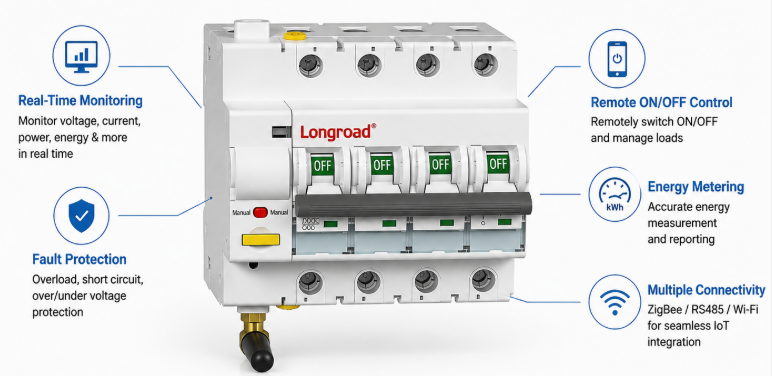
Fundamental Role of Smart Circuit Breakers in IoT Architecture
In modern IoT architecture, a smart circuit breaker serves as the critical intersection between high-power electrical distribution hardware and low-power digital control networks, collecting dynamic electrical telemetry while retaining traditional overcurrent and short-circuit protection capabilities.
A conventional thermal-magnetic circuit breaker relies exclusively on physical bimetallic strip deformation or electromagnetic solenoids to trip a circuit breaker during overload or short-circuit events. While effective for basic safety, traditional circuit breaker design offers zero visibility into real-time current consumption, ambient temperature, transient voltage spikes, or phase imbalances. When a standard circuit breaker trips, facility managers must send technicians to visually inspect the electrical panel board, leading to extended operational downtime and high labor expenses.
By embedding micro-electromechanical sensors, high-precision current transformers, microprocessor control units, and wireless communication transceivers directly into the modular enclosure of the circuit breaker, the unit transitions into an active IoT endpoint. This digital transformation enables the smart circuit breaker to transmit continuous high-frequency data streams regarding active power (kW), reactive power (kVAR), cumulative energy (kWh), power factor, phase current, and internal busbar temperatures. Consequently, the smart circuit breaker converts static breaker panels into smart data hubs.
In distributed IoT networks, the smart circuit breaker functions at the sensing and execution layer. It executes edge logic autonomously—such as tripping under microsecond overvoltage conditions or thermal thresholds—while simultaneously communicating with centralized IoT platforms via gateways. Whether managing critical infrastructure or commercial property, incorporating an intelligent circuit breaker provides operators with total transparency over power quality, system health, and equipment operational states.
Key Technical Features and Hardware Architecture of an IoT Circuit Breaker
The hardware architecture of an IoT smart circuit breaker integrates high-precision current sensors, digital signal processors, motorized or electromagnetic latching operators, and multi-protocol communication transceivers inside a standard DIN-rail footprint.
To understand how a smart circuit breaker operates within IoT networks, one must examine its internal constituent components. The primary sensing block utilizes Rogowski coils or micro-current transformers to capture continuous AC waveforms without magnetic saturation. Alongside voltage divider circuits, these sensors feed raw analog data into an onboard analog-to-digital converter (ADC) connected to a high-speed microcontroller unit (MCU). The MCU calculates true RMS voltage, true RMS current, active power, and total harmonic distortion (THD) in real time.
The switching mechanism of an IoT smart circuit breaker differs substantially from manual molded-case circuit breaker assemblies. It incorporates an integrated micro-motor or motorized solenoid actuator that physically drives the contact mechanism open or closed upon receiving digital control commands. This mechanism retains full mechanical override safety; a physical trip triggered by severe short-circuit currents bypasses digital processing to guarantee immediate interruption within milliseconds. For example, robust industrial distribution setups often deploy a high-capacity 2P Smart MCB ZigBee Industrial Power Distribution circuit breaker to combine rigid dual-pole isolation with high-speed remote telemetry across heavy-duty 230V single-phase industrial equipment lines.
Communication capabilities represent the final essential layer of smart circuit breaker architecture. Depending on application requirements, modules feature ZigBee, RS485 Modbus RTU, Wi-Fi, Ethernet, or cellular NB-IoT communication interfaces. ZigBee and RS485 protocols are particularly favored in dense panel installations due to low power consumption, high immunity to electromagnetic interference (EMI), and mesh networking capabilities that allow multiple circuit breaker nodes to daisy-chain telemetry back to a local gateway.
Hardware Component
Technical Function
Performance Specifications
Current Sensor
Measures continuous AC current flow and transient surges.
Class 0.5S accuracy, 0.1A - 125A measuring range.
Microcontroller (MCU)
Processes signal waveforms, calculates RMS values, handles trip logic.
32-bit ARM Cortex-M architecture with hardware DSP.
Motorized Actuator
Executes remote ON/OFF control commands mechanically.
> 10,000 switching operations, < 100ms response time.
Wireless Transceiver
Transmits data to IoT gateways and receives control packets.
ZigBee 3.0 / 2.4GHz mesh, RS485 Modbus-RTU up to 115200 bps.
Thermal & Leakage Sensor
Detects terminal block overheating and residual earth leakage current.
Temperature threshold 0°C to 100°C; Leakage detection 10mA - 300mA.
Primary Industrial, Commercial, and Smart Building Applications
Smart circuit breaker units are deployed across industrial production plants, commercial facilities, multi-tenant residential complexes, and telecom towers to provide automated load control, remote power restoration, and sub-metering.
In modern commercial building electrical distribution networks, energy management requires granular visibility down to individual branch circuits. Traditional main distribution panels only measure total facility consumption, hiding excessive standby power draw or localized electrical anomalies. Deploying a specialized multi-pole smart circuit breaker—such as a 4P ZigBee Smart MCB Building Electrical Distribution circuit breaker—allows facility managers to monitor and manage three-phase commercial power distribution feeds independently, isolating HVAC units, lighting grids, or server infrastructure remotely via automated scheduling or central dashboard commands.
Industrial manufacturing environments utilize smart circuit breaker nodes to protect expensive machinery while optimizing power quality. In automated manufacturing facilities, inductive loads from heavy motors and variable frequency drives (VFDs) often induce harmonic distortion and phase imbalances. An IoT smart circuit breaker continuously calculates power factor and harmonic metrics, warning engineers before reactive power penalties or motor overheating occur. Furthermore, in unmanned facilities like telecom remote base stations or solar farm combiner boxes, remote circuit breaker resetting capabilities eliminate the need for emergency field technician dispatches following minor transient overvoltage trips.
Commercial real estate operators and flexible co-working space managers also leverage smart circuit breaker setups for sub-metering and automated billing. By capturing precise kilowatt-hour usage per individual tenant or office zone, administrators can generate automated, error-free utility invoices based on exact real-time consumption data rather than arbitrary square-footage estimations. This granular oversight aligns directly with European and global energy efficiency mandates such as ISO 5001.
Core Operational Benefits of Implementing Smart Circuit Breaker Solutions
The deployment of smart circuit breaker technology yields quantifiable operational advantages, including 30% faster fault isolation, reduced unscheduled downtime, automated energy conservation, and improved predictive maintenance.
Real-Time Fault Diagnosis and Automated Alerts
When a standard circuit breaker trips, determining whether the cause was a thermal overload, a direct short circuit, an earth leakage fault, or a temporary voltage spike requires manual multimeter troubleshooting. In contrast, an IoT smart circuit breaker logs the exact electrical values occurring millisecond prior to the trip event. The smart circuit breaker immediately pushes an alarm notification via MQTT or WebSocket to mobile devices or control systems, specifying the exact cause, fault current magnitude, and timestamp.
Predictive Maintenance and Thermal Health Monitoring
Loose terminal screw connections are a leading cause of electrical fires in industrial distribution panels. As connection resistance increases, localized heat rises rapidly. Advanced smart circuit breaker devices incorporate embedded temperature sensors at the wiring terminals. When terminal temperatures exceed configured thresholds (e.g., 75°C), the circuit breaker alerts maintenance teams long before insulation breakdown or catastrophic electrical fire occurs, transitioning maintenance strategy from reactive to predictive.
Automated Energy Optimization and Scheduled Load Shedding
Commercial facility electricity tariffs frequently include peak demand charges calculated based on maximum power draw during peak hours. IoT integrated smart circuit breaker systems can be programmed with automated load shedding rules. When total facility power draw approaches peak tariff thresholds, non-critical branch circuits protected by smart circuit breaker units—such as secondary ventilation or ornamental lighting—are automatically opened temporarily, shaving peak demand and reducing utility expenses.
Remote Control and Centralized Multi-Site Fleet Management
For enterprises operating multiple distributed facilities, centralizing power management via smart circuit breaker IoT networks eliminates geographic limitations. Facility directors can view live power consumption across dozens of regional sites on a unified web platform, execute global off-hours power shutdown schedules, and verify circuit breaker status without local manual intervention.
Integration Strategies with Building Energy Management Systems (BEMS)
Integrating smart circuit breaker hardware into Building Energy Management Systems (BEMS) requires a structured multi-layer communications architecture that translates field-level wireless protocols into enterprise IP-based supervisory networks.
Successful BEMS integration relies on robust protocol translation. Field-level smart circuit breaker units communicate via lightweight, low-latency protocols such as ZigBee 3.0 or RS485 Modbus RTU. These field signals terminate at a smart IoT gateway device positioned inside the panel board. The gateway aggregates raw data from multiple circuit breaker units, converts Modbus register maps or ZigBee clusters into standard Ethernet protocols like BACnet/IP, Modbus TCP, or MQTT, and securely transmits packets to local BEMS servers or cloud platforms.
In high-reliability industrial applications, choosing the right physical pole configuration and communication backbone is vital. Deploying an industrial-grade 2P Smart MCB ZigBee Industrial Power Distribution circuit breaker ensures seamless integration with industrial IoT gateways, allowing plant operators to map individual circuit breaker parameters directly into Supervisory Control and Data Acquisition (SCADA) tag databases without custom software drivers.
Data security is another essential consideration when interfacing smart circuit breaker networks with enterprise networks. Because smart circuit breaker devices possess remote switching capabilities, unauthorized access presents a significant operational risk. Modern IoT circuit breaker implementations utilize AES-128 bit encryption at the wireless layer, TLS 1.3 encryption for outbound cloud communication, and role-based access control (RBAC) to ensure that only authorized control commands can initiate circuit breaker state changes.
Installation Specifications, Commissioning, and Maintenance Guidelines
Proper installation of an IoT smart circuit breaker requires strict adherence to standardized DIN-rail mechanical mounting, neutral-line power supply connections, antenna clearance, and systematic gateway commissioning.
Installing an IoT circuit breaker differs from installing a standard mechanical circuit breaker because digital electronic sensing and communication modules require continuous power. While standard MCBs only connect in series with phase conductors, a smart circuit breaker typically requires an auxiliary phase and neutral (N) terminal connection to power its internal microcontroller, sensors, and wireless transceivers continuous, even when the main breaker contacts are open.
When retrofitting commercial distribution panels, engineering teams must verify panel space and signal transmission path clearances. Due to the metallic enclosure of industrial panel boards, external antenna extensions or gateway placement inside the cabinet must be evaluated to prevent radio frequency (RF) attenuation. Multi-phase distribution lines require balanced, correctly sized multi-pole breakers; for three-phase four-wire commercial installations, deploying a fully rated 4P ZigBee Smart MCB Building Electrical Distribution circuit breaker ensures full switched neutral protection alongside comprehensive line-to-line telemetry.
Maintenance Guidelines and Operating Principles: Smart circuit breaker units require periodic mechanical and digital verification. Annual preventive maintenance must include:
Thermal scanning of terminal connections under full operational load to verify torque tightness.
Manual verification of the mechanical trip test button to clear mechanical latching contact friction.
Firmware integrity checks via the central IoT management console to ensure security patches are applied.
Signal RSSI auditing to confirm wireless network mesh stability within metal panel enclosures.
Comprehensive Technical Comparison and Selection Criteria
Selecting the optimal smart circuit breaker for a target application involves evaluating breaking capacity (kA), rated current (A), pole count, communication protocol, and specialized safety certifications.
Engineers must not compromise core electrical protection standards when upgrading to smart technology. The short-circuit breaking capacity (Icn) of a smart circuit breaker must equal or exceed the calculated prospective fault current at the installation point in the electrical network (typically 6kA or 10kA for commercial and industrial low-voltage switchboards according to IEC/EN 60898-1 standards).
Furthermore, European and international industrial clients strongly prefer modular designs that fit standard 35mm DIN-rail profiles without requiring custom panel modifications. European facilities frequently emphasize integrated energy metering compliant with MID (Measuring Instruments Directive) standards, enabling direct commercial billing capabilities. Below is a structured engineering selection matrix for evaluating smart circuit breaker specifications:
Selection Parameter
Standard Commercial Application
Heavy Industrial Application
Critical Telecom Infrastructure
Pole Configuration
1P+N, 3P, or 4P
2P or 4P Fully Switched
1P or 2P Switched DC/AC
Short-Circuit Capacity (Icn)
6kA (IEC 60898-1)
10kA - 15kA (IEC 60947-2)
6kA - 10kA
Communication Protocol
ZigBee 3.0 / Wi-Fi
RS485 Modbus / ZigBee Mesh
NB-IoT / Ethernet / 4G
Metering Parameters
kWh, Voltage, Current
True RMS, THD, kVAR, kW, °C
DC Current, Voltage, Ah
Operational Temperature
-5°C to +40°C
-25°C to +70°C
-40°C to +85°C
Future Engineering Trends and Conclusion
The convergence of smart circuit breaker technology and IoT represents a fundamental shift in electrical distribution, transitioning power protection from passive safety isolated hardware into proactive, data-driven edge intelligence.
As industrial automation, commercial real estate management, and renewable energy integrations continue to demand higher levels of energy efficiency and operational uptime, the role of the smart circuit breaker will become increasingly central. Modern facility managers can no longer rely on unmeasured, unmonitored electrical panels. By integrating high-precision sensing, automated motor control, and robust wireless mesh networking into standard DIN-rail breakers, engineers gain complete control over power quality, system health, and operating costs.
Future developments in smart circuit breaker engineering will focus heavily on embedded AI-at-the-edge algorithms. Microcontrollers inside next-generation circuit breaker modules will analyze high-frequency waveform samples directly on the device, recognizing arc fault signatures (AFDD) and predicting equipment motor breakdown before catastrophic failures occur. Adopting smart circuit breaker systems today establishes the digital hardware foundation necessary for fully automated, energy-efficient, and resilient smart grid integration tomorrow.