- Home
-
-

What is an Electric Breaker and How Does it Work in Electrical Systems
Views: 0 Author: Site Editor Publish Time: 2026-06-15 Origin: Site


An electric breaker is an automatic electrical switch designed to protect an electrical circuit from damage caused by excess current, typically resulting from an overload or short circuit, by immediately interrupting the flow of electricity once a fault is detected.
Understanding the nuances of these devices—specifically the evolution toward advanced protection—is essential for facility managers, electrical engineers, and homeowners alike. By transitioning from fixed-capacity hardware to advanced solutions like the highly reliable adjustable current circuit breaker, users can optimize their electrical infrastructure for both safety and efficiency. This article explores the fundamental mechanics of these devices, their integral role in safety, and the technical standards that govern their performance.
Table of Contents
1 What is an Electric Breaker? A Comprehensive Definition
2 The Role of Electric Breakers in Modern Electrical Systems
3 Key Components of Electric Breakers: Structure and Functionality
4 Types of Electric Breakers: Circuit Breakers vs. Fuse Breakers
5 How Electric Breakers Enhance Safety in Electrical Circuits
6 Understanding the Mechanism: How Electric Breakers Detect Faults
7 Industry Standards and Ratings: Ensuring Electric Breaker Reliability
1 What is an Electric Breaker? A Comprehensive Definition
An electric breaker is a sophisticated electromechanical device that serves as the primary guardian of an electrical distribution network by acting as an automatic disconnect switch that interrupts power when anomalous conditions are sensed.
At its core, the electric breaker exists to prevent the catastrophic failure of wiring and equipment. Under normal operating conditions, it allows electricity to flow freely to the load. However, the moment the current magnitude exceeds the pre-defined safety threshold—due to a surge, overload, or a direct short circuit—the breaker acts with incredible speed to break the circuit.
The importance of this device cannot be overstated, especially when dealing with high-capacity residential or commercial loads. For instance, the modern 2P French series circuit breaker offers not just protection, but also integrated energy monitoring, reflecting how these devices have moved from simple switches to essential data-gathering components in modern smart electrical systems.
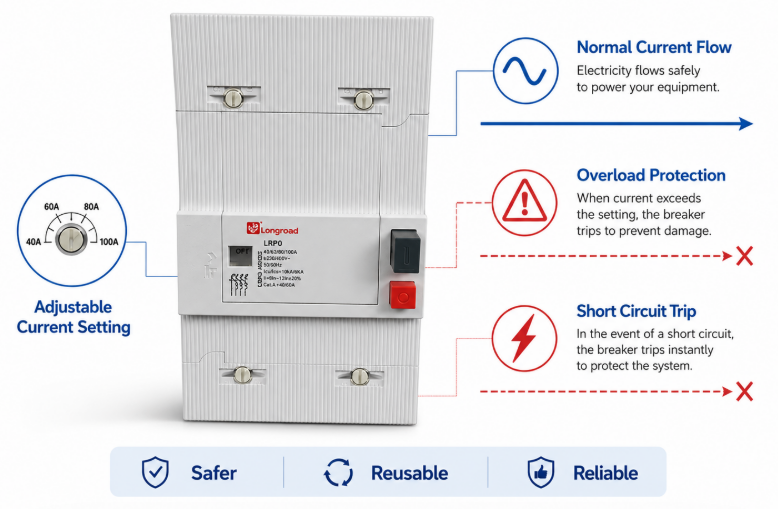
The definition of the modern breaker has evolved to include intelligence. In environments where power consumption fluctuates significantly, an adjustable current circuit breaker provides the flexibility to match the protection levels to the specific requirements of the connected infrastructure, ensuring that the circuit is neither over-protected to the point of nuisance tripping nor under-protected, which could lead to fire hazards.
2 The Role of Electric Breakers in Modern Electrical Systems
Electric breakers are the central hub of electrical safety, providing a reliable method to isolate faults, protect expensive downstream electronics, and maintain power distribution stability across complex building networks.
In contemporary electrical design, the role of the breaker is multi-faceted. It is no longer just about stopping a current; it is about providing visibility into the state of the power supply. As we increase our reliance on sensitive electronics, the speed at which a breaker operates—measured in milliseconds—becomes the difference between a minor incident and a complete equipment burnout.
Furthermore, the integration of advanced functionality, such as remote sensing and energy management, has transformed the breaker into a diagnostic tool. Using an adjustable current circuit breaker allows facility managers to balance load distribution across phases, which prevents localized overheating and significantly extends the lifespan of the entire wiring system within a building.
The system-wide impact is significant:
Fault Isolation: Preventing a single faulty appliance from tripping the entire building's power.
Equipment Protection: Reducing the impact of sudden voltage spikes.
Operational Continuity: Ensuring that essential systems remain energized while faulty zones are safely isolated.
3 Key Components of Electric Breakers: Structure and Functionality
The functionality of an electric breaker relies on a synergistic interaction between its sensing elements, tripping mechanisms, and arc chutes, which work in unison to safely interrupt high-energy electrical currents.
To understand how a breaker functions, one must look inside the chassis. The structural integrity of the breaker is defined by several key components:
The Contacts: These are the physical points that carry the current. When the breaker is "on," they are touching. During a fault, they are forced apart at high speed.
The Tripping Mechanism: This is the "brain" of the breaker. It uses either thermal, magnetic, or electronic sensing to determine when it is time to trip.
The Arc Chute: When contacts separate under load, an electrical arc is formed. The arc chute is a series of metal plates that dissipate the heat and extinguish this arc safely.
The design of an adjustable current circuit breaker must be particularly robust. Because the user can change the trip settings, the internal sensors must be highly calibrated to ensure that even at lower or higher set points, the device remains within its defined safety parameters.
The interaction of these components ensures that even under severe fault conditions where thousands of amps may be flowing, the breaker can safely interrupt the power without welding its contacts together. This reliability is a hallmark of high-quality electrical engineering, where precision manufacturing in the contact assembly and arc suppression chamber is paramount.
4 Types of Electric Breakers: Circuit Breakers vs. Fuse Breakers
While both circuit breakers and fuses serve to interrupt excess current, circuit breakers are re-usable, programmable devices that offer precise control, whereas fuses are sacrificial, single-use components that offer simple but permanent protection.
The choice between a breaker and a fuse is often determined by the environment and the need for operational efficiency. A fuse works by melting a metal filament when current exceeds a limit. This is effective but requires manual replacement and provides no intelligence or feedback to the system.
In contrast, circuit breakers, including the advanced adjustable current circuit breaker, provide several key advantages:
Re-usability: They can be reset after a fault, saving time and maintenance costs.
Versatility: They can be used as local disconnect switches for maintenance.
Programmability: Modern units allow settings to be adjusted based on the specific load profile.
The following table summarizes the key operational differences:
Feature
Circuit Breaker
Fuse
Operational Life
Reusable
Single-use
Maintenance
Simple reset
Requires replacement
Adjustability
High (with adjustable models)
None
Speed of Response
Extremely fast and consistent
Varies based on melting point
5 How Electric Breakers Enhance Safety in Electrical Circuits
Electric breakers are the primary defense against electrical fires and shock, acting as a reliable gatekeeper that monitors current integrity and immediately eliminates hazards the moment a dangerous condition is detected.
Safety is not just about stopping current; it is about how safely that current is stopped. When a breaker acts, it performs a high-energy transition. If not designed correctly, the act of stopping the current could itself cause a fire. This is why the engineering behind the arc suppression mechanism is as important as the tripping logic itself.
An adjustable current circuit breaker enhances this safety profile by allowing the user to match the breaker to the exact characteristics of the circuit. By tailoring the current threshold to the downstream wiring capacity, the risk of over-current heating is mitigated, which is the leading cause of insulation degradation over time.
Beyond fire prevention, modern breakers often include integrated leakage protection. Whether it is an residential energy monitoring breaker or a heavy-duty industrial unit, these devices ensure that even minor ground faults—which can be lethal in wet environments—are detected long before they cause harm to a human occupant.
6 Understanding the Mechanism: How Electric Breakers Detect Faults
The detection of faults within an electric breaker is achieved through three primary methods: thermal bimetallic strips for slow overloads, electromagnetic coils for rapid short-circuit response, and electronic microprocessors for advanced predictive protection.
Most standard breakers use a dual-sensing approach. The thermal element is made of a bimetallic strip that heats up as current passes through it. Under a sustained, moderate overload, the strip bends, triggering the latch to open the breaker. This is ideal for protecting against things like too many appliances plugged into one circuit.
The electromagnetic element is a coil. When a massive, near-instantaneous surge occurs—such as a direct short—the surge of current through the coil creates an intense magnetic field that pulls the latch immediately. This happens in a fraction of a cycle.
For the modern adjustable current circuit breaker, a third layer is added: electronic sensing. This allows the breaker to ignore harmless, momentary "inrush" currents (like those caused by motors starting) while still being hypersensitive to actual faults. This prevents nuisance tripping while maintaining a razor-thin safety margin.
7 Industry Standards and Ratings: Ensuring Electric Breaker Reliability
Industry standards, such as those defined by the IEC and UL, set strict requirements for electric breakers to ensure they perform reliably under specific temperature, humidity, and fault current conditions, preventing premature failure.
Reliability is measured through rigorous testing. A breaker must be able to withstand thousands of mechanical operations and multiple fault-interruption cycles while remaining within its original operating specifications.
The most important ratings are:
Ampere Rating: The continuous current the breaker can handle without tripping.
Interrupting Rating (kA): The maximum fault current the breaker can safely interrupt without being destroyed.
Voltage Rating: The maximum system voltage for which the device is designed.
When selecting an adjustable current circuit breaker, engineers must ensure that all three ratings are appropriate for the specific application. An incorrect selection, particularly in the interrupting rating, could lead to a catastrophic breaker explosion during a short circuit. Therefore, always verify the product documentation to ensure compliance with the specific local and international electrical codes governing your installation.
Conclusion
Electric breakers represent the backbone of modern electrical safety and reliability. By understanding their core function—to act as an intelligent, responsive barrier against electrical faults—we can better appreciate the necessity of selecting the right equipment for any given application. From the basic mechanical operation of the contact assembly to the high-tech, data-driven features of an adjustable current circuit breaker, these devices have evolved into essential components of the modern smart grid. Ensuring the correct selection, installation, and maintenance of these devices remains the most important step in protecting property and personnel from the inherent risks of electricity.