- Home
-
-

What are smart circuit breakers and why you should use them
Views: 0 Author: Site Editor Publish Time: 2026-07-03 Origin: Site


As a senior electrical engineering specialist focusing on industrial power distribution and intelligent energy management, I have spent decades analyzing low-voltage protection architectures across global commercial and industrial facilities. Modern power grids are undergoing an unprecedented transition driven by high-density automation, renewable integration, and rigorous energy efficiency mandates. Traditional protective devices are no longer sufficient to meet modern operational demands. In this technical comprehensive guide, we analyze the operational mechanisms, hardware integration, ZigBee/Wi-Fi wireless topology, and deployment parameters of modern digital protective devices, demonstrating how smart circuit breaker technology transforms static circuit protection into proactive, real-time energy intelligence.
A smart circuit breaker is an advanced electronic electrical protection device that integrates traditional overcurrent and short-circuit protective mechanisms with embedded microprocessors, digital sensors, and wireless communications to monitor electrical parameters in real time, enable remote control switching, optimize power usage, and deliver predictive maintenance insights across commercial and industrial power distribution networks.
Table of Contents
The Evolution of Circuit Breakers
The Technology Behind Smart Circuit Breakers
Advantages of Upgrading to Smart Circuit Breakers
Expanding Capabilities with Smart Circuit Breakers
Key Considerations Before Switching to Smart Circuit Breakers
Choosing the Perfect Smart Circuit Breaker
The Evolution of Circuit Breakers
The evolution of circuit breaker technology represents a shift from mechanical thermal-magnetic protective devices to intelligent electronic systems capable of real-time parameter tracking and digital communication.
For more than a century, electrical distribution systems relied on traditional mechanical protective units designed around bimetallic strips and magnetic solenoids. In a conventional circuit breaker, overcurrent conditions heat the bimetallic element, causing it to bend and mechanically trip the latch, while sudden high-magnitude short-circuit currents energize the magnetic coil to initiate an instantaneous trip. While these electro-mechanical principles provide dependable baseline trip protection against destructive thermal overloads and extreme short circuits, traditional circuit breaker design is inherently reactive, unmetered, and visually non-transparent. Facility managers historically had no visibility into load growth, phase imbalance, or subtle thermal degradation until a physical trip interruption occurred, resulting in unexpected facility downtime.
The introduction of solid-state electronic trip units marked the second major evolutionary phase of the circuit breaker. Electronic trip units substituted mechanical bimetallic structures with current transformers and electronic microprocessors, enabling precise adjustable trip curves, selectable long-time delay, short-time delay, and instantaneous pickup values. This development significantly improved protection coordination and reduced nuisance tripping across complex industrial networks. However, despite their improved measurement accuracy, early electronic circuit breakers remained isolated field components without external network connectivity or automated control capabilities, requiring manual inspection and local parameter adjustment by site engineers.
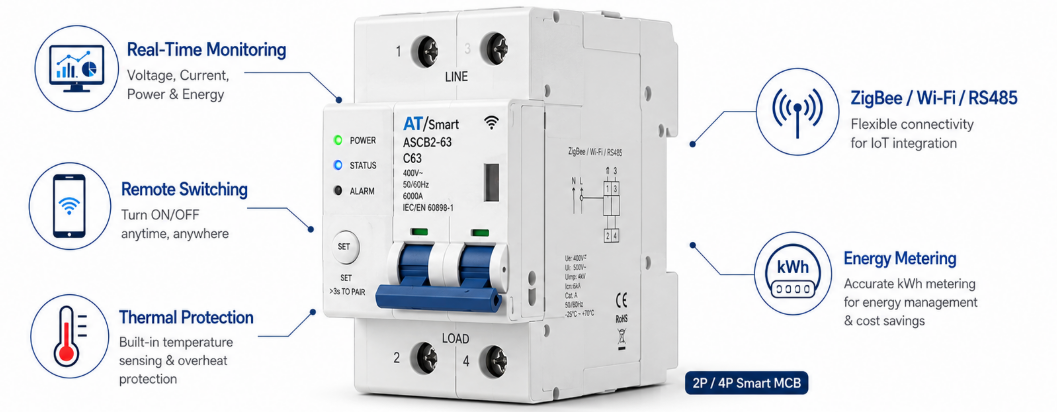
Today, the modern smart circuit breaker represents the complete digital transformation of low-voltage electrical distribution infrastructure. By combining precision current and voltage sensing, onboard microprocessors, motorized actuating mechanisms, and robust wireless communication protocols such as ZigBee, RS485 Modbus, and Wi-Fi, the smart circuit breaker transitions power protection from passive isolation to active asset management. Today, an industrial-grade [2P Smart MCB ZigBee Industrial Power Distribution breaker] enables engineers to continuously log voltage, current, power factor, leakage current, and internal terminal operating temperatures, transmitting high-frequency telemetry directly to edge gateways and cloud analytics platforms for complete facility visibility.
Evolutionary Phase
Primary Protection Mechanism
Data Capabilities
Operational Control
Conventional Circuit Breaker
Bimetallic strip & magnetic solenoid
None (Mechanical trip indication only)
Manual physical reset
Electronic Circuit Breaker
Microprocessor & current transformers
Local digital parameter display
Manual local settings adjustment
Smart Circuit Breaker
Integrated MCU, electronic sensors & motor relay
Real-time voltage, current, energy, temp telemetry
Remote cloud/RS485/ZigBee control & automation
Historical Transition Note: The integration of embedded microcontrollers inside modern miniature circuit breakers allows sampling rates exceeding 1000 measurements per cycle, enabling precise harmonic distortion analysis and sub-cycle arc detection that was completely impossible with mechanical protective equipment.
The Technology Behind Smart Circuit Breakers
The core technology behind a smart circuit breaker consists of integrated sensing modules, an embedded microcontroller, motorized contact actuating mechanics, and wireless or wired communication transceivers.
At the physical hardware layer, a smart circuit breaker integrates high-precision current sensing elements, such as Rogowski coils or current transformers, alongside voltage sampling networks based on resistor dividers. These sensors continuously monitor the sinusoidal electrical waveforms across every active pole. Analog signals are converted into digital values via high-resolution Analog-to-Digital Converters (ADC) and fed directly into an onboard high-speed microcontroller unit (MCU). The MCU runs proprietary signal processing algorithms designed to calculate Real RMS voltage, Real RMS current, active power (kW), reactive power (kVAR), total power factor, active energy consumption (kWh), and frequency in real time with measurement accuracies surpassing class 1.0 energy metering standards.
In addition to electrical parameter measurement, advanced smart circuit breaker hardware incorporates dedicated internal temperature sensors attached directly to the primary line and load terminal blocks. Terminal overheating due to loose wire terminations or contact oxidation is one of the leading causes of electrical fires in industrial distribution panels. When the internal MCU detects terminal temperature exceeding predefined safe operating limits (e.g., 75°C or 85°C), the smart circuit breaker can trigger an automated alarm notification or execute a protective thermal trip before catastrophic insulation degradation occurs. Operating alongside the sensing circuitry, a internal motorized actuator or magnetic latching solenoid allows the MCU to mechanically switch the primary breaker contacts open or closed in response to local trip conditions or remote network commands.
Network connectivity is established using standardized low-power industrial communication protocols. For modular DIN-rail distribution panels housing high densities of protection devices, ZigBee wireless technology based on the IEEE 802.15.4 standard provides an ideal mesh network infrastructure. ZigBee transceivers enable hundreds of smart circuit breaker units to intercommunicate effortlessly with a centralized industrial IoT gateway without complex network cabling. In high-density installations, a compact [4P ZigBee Smart MCB Building Electrical Distribution breaker] acts as a self-healing node within the panel, relaying telemetry across neighboring protective devices to ensure uninterrupted data transmission to the central automation server, building management system (BMS), or cloud platform.
Component Module
Hardware Description
Technical Function
Precision Sensing Unit
Current Transformers / Rogowski Coils & Resistor Voltage Dividers
Samples continuous phase current and voltage waveforms at high sampling frequencies.
Embedded MCU
32-bit ARM Cortex Microprocessor
Executes RMS calculations, thermal protection logic, trip timing curves, and communication framing.
Motorized Actuator
Micro-gear motor / Bi-stable magnetic latching mechanism
Executes physical contact opening and closing operations via electrical control signal.
Wireless Transceiver
ZigBee 3.0 / Wi-Fi (2.4GHz) / RS485 Modbus RTU module
Transmits real-time measurement telemetry and receives remote control execution commands.
Operating Principle: Smart circuit breakers utilize bi-stable magnetic latching mechanisms to maintain physical contact positions without continuous coil power consumption, ensuring zero heat generation within the control electronics during normal closed-circuit operation.
Advantages of Upgrading to Smart Circuit Breakers
Upgrading to smart circuit breakers provides enhanced electrical safety, centralized remote energy monitoring, rapid fault isolation, reduced maintenance costs, and automated energy optimization.
Continuous Real-Time Monitoring and Parameter Visibility
Unlike traditional protective devices that remain idle until a fault occurs, smart circuit breaker technology transforms distribution panels into active data nodes. Facility managers can monitor real-time phase currents, voltage imbalances, power factor drops, and energy usage patterns directly from a centralized software dashboard. This complete parameter visibility allows engineering teams to identify underutilized circuit capacity, detect floating ground conditions, and balance three-phase electrical loads across facility distribution boards effectively.
Remote Switching and Automated Operations
Smart circuit breaker technology enables safe, authorized remote physical switching of individual branch circuits or complete main feeder boards without requiring maintenance technicians to manually access energized distribution enclosures. Through secure encrypted communication protocols, engineers can execute scheduled off-hours power shutdown routines for non-essential commercial loads, perform soft system restarts, or remotely open individual circuits during emergency isolation protocols, significantly improving site operational efficiency.
Predictive Maintenance and Early Fault Detection
By continuously tracking current waveforms, residual ground leakage currents, and terminal connection temperatures, smart circuit breakers detect subtle electrical anomalies long before they escalate into catastrophic short circuits or equipment failure. Utilizing an industrial-grade [2P Smart MCB ZigBee Industrial Power Distribution breaker], industrial engineering teams can set customized pre-alarm thresholds for creepage current and thermal drift, allowing technicians to rectify loose terminal screws or failing load insulation during planned routine maintenance windows rather than experiencing costly unscheduled production outages.
Operational Metric
Traditional Circuit Breaker
Smart Circuit Breaker
Fault Identification Time
Manual physical inspection (Hours/Days)
Instantaneous push notification (< 1 Second)
Energy Metering Accuracy
None (Requires external panel meters)
Integrated Class 1.0 RMS digital metering
Terminal Heat Detection
Periodic manual thermography scans
24/7 continuous internal thermal sensor tracking
Control Flexibility
Local physical toggle operation only
Automated, scheduled, and remote app/BMS control
Expanding Capabilities with Smart Circuit Breakers
Smart circuit breakers expand modern facility capabilities through advanced load management, automated peak shaving, integrated renewable microgrid synchronization, and granular sub-metering.
In modern industrial facilities and commercial buildings, managing electrical demand charges and dynamic energy pricing is vital for operational profitability. Smart circuit breaker installations allow facility managers to implement sophisticated automated load shedding and peak shaving algorithms. When total building demand approaches peak tariff limits, the central management platform communicates with designated smart circuit breakers to sequentially disconnect non-critical secondary loads, such as electric vehicle charging stations, supplemental HVAC units, or decorative lighting, ensuring the facility stays within contract power thresholds without disrupting critical production machinery.
Furthermore, smart circuit breakers play a pivotal role in modern renewable energy integration and microgrid management. With the increasing adoption of onsite solar photovoltaic (PV) arrays, battery energy storage systems (BESS), and bidirectional power flows, distribution networks require flexible protective devices that can monitor directional power flow and adapt trip curves accordingly. Smart circuit breaker hardware can detect reverse power flow conditions, monitor microgrid islanding status, and automatically reconfigure branch distribution paths during main grid outages to preserve uninterrupted power supply to essential industrial processes.
Deploying multi-pole digital protective devices such as a [4P ZigBee Smart MCB Building Electrical Distribution breaker] enables precise four-pole neutral-line and phase-line sub-metering across three-phase four-wire commercial distribution systems. This detailed sub-metering data integrates seamlessly into enterprise energy management software (EMS) via open API interfaces or Modbus protocols, allowing facility accountants to allocate precise energy costs to individual tenant departments, manufacturing lines, or specific heavy machinery units.
Advanced Feature
Technical Implementation
Industrial Application
Automated Peak Shaving
Threshold-triggered automated remote tripping
Reduces high-demand utility penalty surcharges in industrial plants.
Neutral Line Monitoring
4-Pole current and voltage harmonic sampling
Detects neutral conductor overheating in nonlinear commercial IT loads.
Microgrid Synchronization
Bidirectional directional current & frequency tracking
Manages seamless switching between grid-tied solar storage and isolated backup power.
Granular Sub-metering
High-precision kWh accumulation & logging
Allocates precise departmental power expenses in commercial facilities.
Maintenance Tip: When deploying smart circuit breaker arrays in high-density panels, always establish scheduled firmware updates through the ZigBee gateway or local RS485 communication line during low-demand periods to maintain updated cybersecurity protocols and optimal communication stability.
Key Considerations Before Switching to Smart Circuit Breakers
Before switching to smart circuit breakers, engineering teams must evaluate electrical breaking capacity, physical enclosure footprint, communication network topology, software compatibility, and safety compliance standards.
Short-Circuit Breaking Capacity (Icu/Ics) and Trip Characteristics
While smart circuit breakers offer advanced electronic and digital monitoring capabilities, their primary function remains fundamental electrical protection. System designers must ensure that the smart circuit breaker selected possesses an adequate ultimate short-circuit breaking capacity (Icu) and service short-circuit breaking capacity (Ics) matching or exceeding the prospective fault current at the installation point (e.g., 6kA, 10kA, or 15kA according to IEC/EN 60898-1 or IEC/EN 60947-2 standards). Additionally, selecting the correct instantaneous tripping characteristic (such as Type B for resistive loads, Type C for standard commercial equipment, or Type D for high inrush inductive motor loads) is critical to prevent nuisance tripping.
Physical DIN-Rail Footprint and Mechanical Dimensions
Upgrading traditional standard miniature circuit breakers (MCBs) to smart circuit breaker units requires careful verification of physical dimensions within distribution boards. While modern smart circuit breaker designs maintain standard 18mm module widths per pole to fit standard 35mm DIN-rail profiles, the internal addition of motorized actuators and communication modules may increase overall unit depth or height. Engineering teams must inspect enclosure internal depth clearances and terminal wire bending radii before specifying retrofits in existing shallow wall-mounted panels.
Communication Infrastructure and Wireless Signal Coverage
The performance of a smart circuit breaker system relies heavily on the reliability of its underlying communication network. In industrial environments where heavy steel switchgear cabinets, concrete walls, and electromagnetic interference (EMI) are prevalent, wireless communications such as ZigBee or Wi-Fi require structured signal planning. Utilizing ZigBee mesh topologies helps mitigate signal degradation because each powered smart circuit breaker acts as a signal repeater. However, in heavily shielded metal enclosures, installing external gateway antennas or adopting RS485 Modbus wired connections may be required to ensure robust network connectivity.
Evaluation Parameter
Technical Requirement Standard
Selection Guideline
Short-Circuit Rating
IEC 60898-1 / IEC 60947-2
Must match maximum calculated prospective fault level (6kA - 10kA standard).
Tripping Curve Type
Type B, C, or D Curve
Select Type C for general commercial, Type D for heavy inductive transformer/motor loads.
Wireless Mesh Protocol
ZigBee 3.0 / IEEE 802.15.4
Ensure maximum gateway-to-device node distances remain within 15 meters in industrial panels.
Operating Temperature
-25°C to +70°C
Verify panel ventilation and temperature derating factors in high-ambient environments.
Choosing the Perfect Smart Circuit Breaker
Choosing the perfect smart circuit breaker involves evaluating required pole count, rated operating current, target communication network, integrated metering capabilities, and specific B2B deployment requirements.
Determine the Required Pole Configuration and Rated Current
The first step in selecting a smart circuit breaker is identifying the exact circuit configuration and load requirements. Single-pole (1P) and single-pole with neutral (1P+N) units are ideal for single-phase branch lighting and socket circuits. Two-pole (2P) breakers are typically chosen for single-phase industrial power feeds requiring double-pole isolation. For three-phase four-wire industrial power distribution systems and commercial main feeder boards, choosing a four-pole unit such as a [4P ZigBee Smart MCB Building Electrical Distribution breaker] ensures complete isolation and continuous measurement across all three active phases and the neutral conductor.
Select the Optimal Communication Protocol and Software Integration
Depending on the overall facility automation architecture, choose a communication protocol that aligns with your existing network infrastructure. ZigBee 3.0 offers maximum flexibility for retrofit applications where adding control wiring inside crowded distribution boards is impractical. In contrast, RS485 Modbus RTU is preferred in heavy industrial plants with existing PLC controls and SCADA networks. Ensure that the smart circuit breaker manufacturer provides open Modbus register maps or accessible API documentation to simplify integration into third-party Building Management Systems (BMS).
Assess Industrial Design Preferences and European Market Requirements
Based on extensive B2B market feedback and European client preferences, optimal smart circuit breaker design prioritizes modularity, dual-lock DIN-rail mounting clips, tool-free wiring terminals, and transparent visual status indicators. European installation engineers strongly prefer smart circuit breaker models featuring physical lock-out tag-out (LOTO) mechanical switches directly on the front panel, allowing maintenance technicians to mechanically lock the contacts in the OPEN position during physical servicing, completely overriding any incoming remote electronic close signals for maximum electrician safety.
Verify Integrated Electrical Protections and Custom Threshold Settings
A high-performance smart circuit breaker must combine comprehensive software-configurable protections with mechanical trip safety. Key protection parameters that should be fully adjustable via software or app configuration include overvoltage protection thresholds (e.g., 250V-300V), undervoltage protection thresholds (e.g., 150V-220V), overcurrent limits, leakage current protection (e.g., 10mA-300mA adjustable), and internal terminal over-temperature trip limits. Selecting devices with adjustable trip delays prevents false tripping during transient voltage surges or motor startup currents.
Selection Criteria
Key Technical Specification
Recommended Application Fit
Single-Phase Branch Circuit
1P / 1P+N / 2P (16A - 32A, Type C Curve)
Commercial branch lighting, server rack PDU protection, small office sub-panels.
Industrial Power Distribution
2P / 3P / 4P (32A - 100A, Adjustable Trip)
Heavy manufacturing equipment, motor control centers, sub-distribution feeder panels.
Building Energy Management
4P ZigBee / RS485 Modbus (Class 1.0 Metering)
Commercial floor main boards, tenant sub-metering, renewable solar storage integration.
High-Safety Industrial Environments
Integrated LOTO switch & Thermal Sensors
Facilities requiring strict electrician safety protocols and preventive maintenance tracking.
Product Engineering Insight: Why are modern industrial smart circuit breakers engineered with dual mechanical-electronic contact structures? In industrial applications, client feedback consistently emphasizes that physical mechanical safety isolation must never be compromised by software bugs or electronic component failure. Therefore, top-tier smart circuit breaker designs feature a true mechanical trip linkage that operates independently of the electronic microcontroller, guaranteeing positive physical isolation under severe short-circuit fault conditions.
Conclusion and Future Outlook
The transition from traditional mechanical power protection to modern smart circuit breaker technology marks a monumental shift in low-voltage electrical distribution. By combining dependable electro-mechanical short-circuit protection with advanced digital microcontrollers, real-time current and voltage telemetry, terminal thermal sensing, and low-power wireless mesh protocols, the smart circuit breaker converts basic electrical panels into proactive digital energy assets. Whether deployed in commercial building distribution boards or heavy industrial manufacturing plants, upgrading to smart circuit breakers delivers immediate operational benefits—including reduced downtime, precise energy sub-metering, predictive thermal maintenance, and seamless integration into modern IoT building management platforms.
As smart grid standards, renewable energy microgrids, and strict energy efficiency mandates continue to evolve globally, specifying smart circuit breaker infrastructure is no longer merely an option for facility managers—it is a critical foundational requirement for sustainable, efficient, and resilient electrical power distribution networks.