- Home
-
-

What Is an Adjustable Circuit Breaker?
Views: 0 Author: Site Editor Publish Time: 2026-05-26 Origin: Site


An adjustable circuit breaker is an advanced electrical protection device featuring integrated, adjustable trip units that allow field technicians to manually program or digitally configure precise current thresholds, long-time delay behaviors, short-time pickup parameters, and instantaneous trip points to match specific operational loads and system demands.
Understanding the internal engineering, configuration procedures, and strategic applications of an adjustable current circuit breaker is essential for optimizing system efficiency and ensuring strict compliance with international safety codes. This comprehensive guide details the mechanical and electronic trip technologies that drive these versatile devices, provides comparative structural data, and outlines structured methodologies for selecting and configuring them. Implementing these solutions enables engineering teams to build resilient power networks capable of sustained, high-efficiency industrial performance.
The following technical sections provide an exhaustive analysis of these high-performance industrial components, detailing everything from basic component design to complex coordination strategies across industrial distribution facilities:
Understanding the Fundamentals: Fixed vs. Adjustable Circuit Breakers
How Adjustable Circuit Breakers Work: Trip Unit Technologies
Applications: When to Use Adjustable Circuit Breakers
How to Adjust Circuit Breaker Settings: Step-by-Step Guide
Advantages and Limitations of Adjustable Circuit Breakers
Selecting the Right Adjustable Circuit Breaker
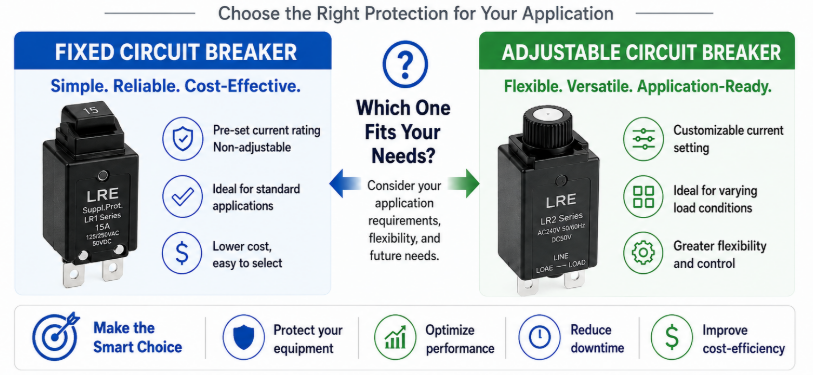
Understanding the Fundamentals: Fixed vs. Adjustable Circuit Breakers
The foundational distinction between a fixed circuit breaker and an adjustable circuit breaker lies in the versatility of the trip unit, where fixed units operate on immutable pre-set thermal-magnetic values while adjustable units provide variable current rating configurations.
Fixed circuit breakers are manufactured to trip at a singular, unchangeable nominal current value, which is determined during factory production and cannot be altered afterward. For instance, a standard 100-Amp fixed breaker will consistently initiate its overcurrent protection routine whenever current continuously exceeds its specific factory threshold. This rigidity makes fixed options highly efficient for standard domestic applications, uniform branch circuit protection, and localized residential panels where load characteristics remain predictable and static over decades of operation. However, in heavy industrial manufacturing environments where production lines expand and large machinery is routinely upgraded, relying entirely on fixed mechanisms creates significant operational bottlenecks.
Conversely, incorporating an adjustable current circuit breaker gives engineers the operational freedom to fine-tune protection parameters directly in the field. These devices feature a flexible electronic or thermal-magnetic trip architecture that allows users to adjust the nominal continuous current rating across a broad range, such as from 70 Amps up to 100 Amps on a single frame. This means a single physical asset can serve multiple operational configurations, adapting effortlessly to shifting plant layout designs, new machinery installations, or temporary load fluctuations without requiring costly electrical downtime to change physical components. Field personnel can easily adjust settings using integrated rotatable dials or clear digital menus to achieve optimal circuit protection.
To highlight these core operational and physical differences more clearly, the table below provides a detailed structural comparison across key performance metrics:
Performance Metric Fixed Circuit Breaker Adjustable Current Circuit Breaker Current Rating Flexibility Completely static; locked at factory specifications. Highly dynamic; field-adjustable across a broad range. Inventory Management Cost High; requires stocking distinct units for each unique amp value. Low; a single frame size covers multiple system ratings. System Integration Suitability Ideal for predictable, low-variation commercial or residential loads. Engineered for complex industrial, variable, and high-capacity grids. Coordination Precision Basic; limited by predefined fixed curves. Advanced; precise time-current curve shaping options. Choosing an adjustable current circuit breaker over fixed hardware represents a strategic transition toward smart industrial grid automation. In high-power distribution centers, achieving precise coordination between upstream and downstream breakers is critical for maintaining uptime. If a fault occurs in a deep sub-branch, a properly configured adjustable breaker isolates only that specific area, preventing widespread, cascading outages across the entire facility. This high level of control is impossible with rigid, fixed devices, which lack the precise calibration needed to resolve complex, modern industrial power faults effectively.
How Adjustable Circuit Breakers Work: Trip Unit Technologies
Adjustable circuit breakers operate by utilizing sophisticated internal trip units that monitor current flow via electromagnetic mechanisms or digital microprocessors to trigger mechanical separation when custom thresholds are crossed.
The mechanical performance and response accuracy of these devices depend primarily on the type of trip unit technology integrated into the chassis. Traditional high-performance adjustable options utilize thermal-magnetic trip units, which combine two distinct physical principles to deliver reliable overcurrent and short-circuit protection. The thermal component uses a carefully calibrated bimetallic strip that bends progressively when exposed to continuous overcurrent, mechanical heat build-up, or overload conditions. An adjustable mechanical dial modifies the physical distance between this bimetallic element and the trip latch mechanism, allowing operators to change the continuous current rating threshold directly. Meanwhile, the magnetic component relies on a robust electromagnetic coil that instantly unlatches the breaker during massive short-circuit currents, providing vital near-instantaneous localized protection.
For demanding, high-capacity industrial systems, advanced electronic trip units (ETUs) offer superior precision compared to mechanical options. These state-of-the-art units utilize internal current transformers to continuously sample current wave profiles across every phase. The collected data is fed into an onboard digital microprocessor that executes real-time diagnostics. This digital structure enables precise configuration of the entire protection curve, commonly referred to by engineers as the LSI portfolio. The LSI framework stands for Long-time delay for overload protection, Short-time delay for selective short-circuit coordination, and Instantaneous pickup for catastrophic fault mitigation. Utilizing high-efficiency solutions like a premium adjustable current circuit breaker ensures industrial operations can manage highly variable, non-linear harmonic loads without triggering frustrating nuisance trips.
To illustrate the detailed functionality of electronic trip units, the following layout outlines the core adjustments available on a standard industrial LSI profile:
Long-Time Pickup & Delay (L): Determines the continuous amperage rating of the breaker and establishes how long the system will tolerate minor, non-damaging overloads before tripping.
Short-Time Pickup & Delay (S): Sets the current threshold and specific millisecond delay for mid-level short circuits, enabling downstream breakers to clear faults first.
Instantaneous Pickup (I): Bypasses all intentional time delays to immediately isolate the circuit when catastrophic, extreme short circuits occur.
Ground Fault Protection (G): Monitors vector current imbalances to identify stray current leakage, protecting equipment from severe internal insulation failures.
Microprocessor-driven electronic systems also offer advanced data logging, network connectivity, and real-time power monitoring features. Operators can view historical trip waveforms, track continuous power quality metrics, and transmit diagnostics to centralized control rooms via industry-standard protocols like Modbus or Profibus. This steady flow of actionable data transforms the device from a simple emergency safety switch into an active, intelligent asset for predictive facility maintenance. This connectivity helps minimize unexpected downtime and significantly extends the operational lifespan of downstream motors, generators, and industrial processing equipment.
Applications: When to Use Adjustable Circuit Breakers
Adjustable circuit breakers are utilized in dynamic industrial plants, critical data centers, large commercial complexes, and renewable energy facilities where load requirements frequently change and maximizing system uptime is essential.
In heavy industrial processing environments and manufacturing facilities, power requirements change constantly as machinery is upgraded or production lines are reconfigured. For example, a factory floor might replace an older 50-HP motor with a high-efficiency 75-HP unit that exhibits entirely different inrush current characteristics. In this scenario, a fixed protective device would require full replacement, forcing the company to buy new hardware and endure extended downtime during installation. In contrast, using a flexible adjustable current circuit breaker allows technicians to simply adjust the trip settings to accommodate the new motor's operating profile. This adjustment optimizes protection and keeps production lines running smoothly with minimal intervention.
Critical data facilities, hospital complexes, and advanced telecommunication hubs represent another vital application area where power continuity is paramount. These facilities require specialized selectivity designs to ensure localized electrical faults do not trigger wide-scale system shutdowns. By carefully calibrating the short-time delay and current pickup points on adjustable units throughout the power distribution hierarchy, engineers can ensure that a fault inside an individual server rack is isolated by its immediate breaker. This localized isolation prevents the main upstream distribution breaker from tripping, safeguarding the rest of the facility's critical infrastructure. This reliable performance prevents costly data loss, protects sensitive electronic components, and avoids expensive disruptions to vital services.
The primary application sectors and their specific deployment scenarios are detailed below:
Industrial Manufacturing Automation: Protecting heavy-duty motor control centers, automated assembly lines, and high-capacity processing equipment subject to variable operational loading.
Critical Mission Infrastructure: Maintaining absolute power continuity in data centers, hospital emergency units, and government communication hubs through precise fault isolation.
Commercial Real Estate Hubs: Managing shifting HVAC configurations, variable lighting grids, and office tenant layout re-engineering projects across large commercial high-rises.
Renewable Energy Systems: Balancing highly fluctuating generation profiles from utility-scale solar arrays, wind turbine installations, and massive battery energy storage systems (BESS).
Additionally, modern green energy generation facilities present unique power challenges due to the naturally intermittent output of wind and solar sources. Distributed generation networks often experience unpredictable bi-directional power flows and fluctuating short-circuit current capacities throughout the day. Deploying a high-performance adjustable current circuit breaker gives grid operators the flexibility needed to continuously adapt protective trip curves to these changing generation profiles. This active, dynamic protection optimization safeguards expensive inverters and transformers while helping maintain grid stability.
How to Adjust Circuit Breaker Settings: Step-by-Step Guide
Adjusting circuit breaker settings requires executing a precise sequence of technical verification steps, calculation models, dial adjustments, and field validation tests to ensure safe operational alignment.
Before modifying any parameters on a live power distribution asset, engineers must perform a comprehensive electrical coordination study using specialized system modeling software. This technical study generates clear, verified time-current curves that dictate the ideal mathematical settings for every adjustable parameter across the facility. Attempting to adjust dials based on guesswork or unverified estimates can result in catastrophic equipment damage or severe safety hazards, such as compromised arc-flash boundary protection. Once the engineering calculations are finalized and approved, technicians must acquire all specified personal protective equipment (PPE) required by relevant electrical safety standards before approaching the physical enclosure.
Once safe access is established, the physical adjustment process can proceed systematically, depending on whether the unit utilizes analog rotary dials or an advanced electronic interface. For digital trip units, technicians can connect a certified programming laptop or utilize the integrated LCD navigation screen to enter the password-protected configuration menu. It is crucial to verify that the breaker's frame rating is perfectly matched with the target continuous current demand before saving any changes. Utilizing an industry-approved adjustable current circuit breaker with clear setting markers makes this process highly accurate, minimizing human error and ensuring precise field calibration.
To ensure repeatable accuracy during field modifications, technicians should follow this structured step-by-step procedural framework:
Step Operational Activity Technical Target & Verification Action 1 Coordination Study Execution Run full digital simulations to establish exact LSI target coordinates based on actual system parameters. 2 Isolation and De-energization Safely disconnect power sources wherever feasible and verify a zero-energy state using calibrated voltage testers. 3 Continuous Rating Calibration Set the long-time dial (Ir) to match the calculated continuous load current of the downstream network. 4 Short-Time & Instantaneous Setup Adjust short-time pickup (Isd) and instantaneous settings (Ii) to manage inrush currents without sacrificing protection. 5 Secondary Injection Validation Connect specialized testing sets to inject simulated fault currents, confirming the breaker trips within specified limits. 6 Official Documentation & Sealing Record all final values in the facility asset management log and apply tamper-evident physical seals over dials. After finalizing the physical or digital settings, technicians must perform secondary injection testing to validate the breaker's actual performance. This testing involves connecting a specialized diagnostic instrument that injects precise, low-level simulated fault currents directly into the trip unit's microprocessor. By measuring the exact time it takes for the breaker to trip at various current levels, engineers can verify that the device operates exactly as predicted by the coordination software. Once validated, the settings must be securely logged, and the physical protective cover must be locked to prevent unauthorized changes by unqualified personnel.
Advantages and Limitations of Adjustable Circuit Breakers
The primary advantages of adjustable circuit breakers include superior system flexibility, reduced long-term inventory costs, and precise fault isolation, while their main limitations center on higher upfront costs and the need for specialized engineering oversight.
The operational flexibility provided by adjustable trip settings significantly reduces lifetime asset management expenses for large facilities. Instead of purchasing and maintaining an extensive inventory of distinct fixed circuit breakers for every minor variation in machinery loads, companies can stock a few standardized frame sizes. This consolidation streamlines warehouse operations, reduces upfront procurement expenses, and simplifies maintenance routines for service technicians. Additionally, the ability to fine-tune protection parameters on site prevents unnecessary nuisance trips caused by high motor inrush currents, helping facilities maintain steady production levels and avoid costly operational downtime.
However, realizing these operational benefits requires a higher initial capital investment compared to purchasing simpler, fixed-rated protective switches. The advanced internal components, current transformers, and microprocessors used in electronic trip units naturally increase manufacturing costs. Furthermore, because these units feature adjustable settings, they require ongoing professional engineering oversight, regular calibration reviews, and detailed coordination studies. If an untrained technician incorrectly adjusts a short-time delay dial, it can disrupt the coordination of the entire downstream network, potentially causing widespread, unnecessary blackouts during minor localized faults. Therefore, facilities must commit to ongoing training and strict maintenance protocols to ensure safe, reliable long-term performance.
A concise summary of these key benefits and constraints is detailed below:
Enhanced Selectivity Design: Allows precise tuning of time-delay curves to ensure localized faults are isolated without disrupting upstream distribution networks.
Reduced Asset Inventory: Standardizing a few versatile frame sizes across a facility slashes warehouse overhead and simplifies spare parts management.
Mitigation of Nuisance Trips: Allows customization of current thresholds to handle unique transformer and heavy motor inrush patterns smoothly.
Higher Initial Capital Cost: Demands a larger upfront budget for the advanced microprocessor and digital sensor architecture.
Complexity and Human Error Risk: Requires skilled engineering oversight to prevent incorrect settings that could lead to dangerous arc-flash hazards or system blind spots.
When evaluating these trade-offs, engineering teams must consider the total cost of ownership rather than just the initial equipment price. For high-capacity industrial plants, data centers, and critical commercial facilities, the financial losses from a single unplanned power outage can easily exceed the cost premium of advanced protective hardware. Investing in a high-quality adjustable current circuit breaker provides long-term financial security by minimizing system downtime, enabling rapid facility modifications, and protecting expensive downstream infrastructure from severe electrical stresses.
Selecting the Right Adjustable Circuit Breaker
Selecting the ideal adjustable circuit breaker requires thoroughly analyzing the total system voltage, maximum short-circuit interrupting capacity, continuous operational load patterns, and structural environmental conditions.
The first critical parameter to evaluate during procurement is the maximum short-circuit interrupting rating, often specified in kiloamperes (kA). This rating defines the absolute highest level of fault current the breaker can safely interrupt without experiencing structural failure or posing a safety risk to nearby personnel. Engineers must calculate the available short-circuit current at the exact installation point using precise transformer impedance data and cable length metrics. Selecting a breaker with an insufficient interrupting capacity can lead to catastrophic hardware failure during severe short circuits. Therefore, choosing a robust adjustable current circuit breaker with an appropriate interrupting rating is essential for maintaining safety margins.
Next, engineers must select an appropriate frame size that comfortably accommodates the circuit's long-term continuous current needs. Frame sizes represent the physical dimensions and structural capacities of the breaker housing, with typical industrial options ranging from 125 Amps to over 3000 Amps. While the trip unit allows operators to adjust the actual operating current threshold down to a fraction of the nominal rating, the physical frame must be robust enough to handle continuous peak currents without overheating. For example, if a system currently requires a 400-Amp threshold but is expected to expand to 600 Amps in the future, it is wise to install an 800-Amp frame equipped with an adjustable electronic trip unit. This approach enables easy future power upgrades without requiring expensive retrofitting or complete physical replacement of the main breaker chassis.
To help procurement teams evaluate options, the following comparison matrix details the primary adjustable breaker configurations and their typical applications:
Breaker Class Type Typical Frame Range Interrupting Range (kA) Primary Engineering Target Application Molded Case (MCCB) 15A to 1600A 15 kA to 150 kA Industrial motor control, commercial panels, branch sub-distribution networks. Insulated Case (ICCB) 400A to 5000A 50 kA to 200 kA Main distribution switchboards, heavy manufacturing centers, large commercial facilities. Low-Voltage Air (LVACB) 800A to 6300A 65 kA to 150 kA Main power generation stations, utility substations, critical data center infrastructure. Finally, engineering teams must ensure that the selected equipment complies with all relevant international safety and performance standards, such as UL 489, IEC 60947-2, or CE certification. These rigorous manufacturing certifications guarantee that the device has undergone extensive testing under extreme conditions, including repeated full-load switching and high-temperature exposure. Additionally, teams should evaluate environmental factors like ambient operating temperatures, humidity levels, and potential exposure to airborne contaminants. Specifying appropriate protective enclosures, conformal coatings on internal electronic boards, or necessary thermal derating factors ensures the system delivers dependable, long-term performance in demanding industrial environments.
Adjustable Current Circuit Breaker commercial smart circuit breaker certified Residual Current Circuit Breaker precise Miniature Circuit Breaker compact Miniature Circuit Breaker dependable circuit breaker responsive Molded Case Circuit Breaker trusted circuit breaker practical Miniature Circuit Breaker