- Home
-
-

Outlet Circuit Breakers: A Critical Component for Electrical Safety
Views: 0 Author: Site Editor Publish Time: 2026-06-20 Origin: Site


The core function of an outlet circuit breaker is to provide a reliable, automated safety mechanism that interrupts the electrical supply when an overcurrent, short circuit, or fault is detected, thereby preventing overheating, equipment damage, and electrical fires.
Understanding the nuances of these devices is essential for property owners, facility managers, and electrical engineers alike. By implementing high-performance solutions, such as an advanced adjustable circuit breaker for utility service connections, stakeholders can significantly enhance system stability and reduce the likelihood of hazardous power failures. This article delves into the critical role of circuit breakers, the technical advantages of modern adjustable designs, and best practices for optimizing electrical safety across diverse applications.
Directory of Contents
Section
Summary
Importance of Electrical Safety
Explains the fundamental role of circuit breakers as the first line of defense against electrical hazards.
The Mechanics of Protection
Details how breakers identify faults and why timely interruption is critical to system integrity.
Why Choose Adjustable Current Circuit Breakers
Highlights the flexibility and precision of modern electronic trip options over traditional fixed devices.
Applications in Energy Management
Discusses the utility of specialized breakers in residential energy metering and infrastructure.
Selecting the Right Circuit Protection
Provides a framework for matching breaker specifications to specific operational and load requirements.
Importance of Electrical Safety
Electrical safety is the foundational pillar of building infrastructure, ensuring that power distribution systems function within safe parameters to protect occupants, sensitive electronics, and structural assets from the catastrophic effects of electrical fires and power surges.
The necessity of electrical safety cannot be overstated. In an era where homes and businesses are increasingly powered by complex arrays of appliances and smart devices, the demand on electrical circuits has shifted from static, predictable loads to highly variable consumption patterns. Without the active protection provided by a properly installed circuit breaker, an unexpected power surge or a prolonged overload could lead to melted wiring, destroyed insulation, and potentially devastating fires.
Beyond fire prevention, modern electrical safety focuses on the continuity of power. An effective protection strategy ensures that when a fault occurs, it is isolated precisely at the source. This selective protection is critical, as it prevents a localized fault from triggering a total system blackout. By maintaining the integrity of the wider network, a robust safety strategy protects valuable equipment—such as HVAC systems, lighting arrays, and server racks—from the degradation caused by inconsistent voltage or recurring electrical noise.
Moreover, the regulatory landscape emphasizes that safety systems must be regularly inspected and upgraded. Older, fixed-trip breakers may not offer the precision required for today’s energy-efficient devices. Moving toward more responsive safety standards, many professionals are now opting for high-performance equipment, such as 2P French Series Circuit Breakers for residential energy metering, which offer not only basic fault protection but also integration capabilities that align with modern energy efficiency mandates.
The Mechanics of Protection
A circuit breaker serves as a sophisticated mechanical or electronic switch that continuously monitors current flow and triggers an immediate disconnection of power when defined threshold limits for overloads or short circuits are breached.
The mechanism within a circuit breaker is designed to balance sensitivity and reliability. At its most basic level, a thermal-magnetic breaker uses a bimetallic strip that bends when heated by excess current, eventually tripping the latch. In more advanced electronic designs, sensors detect the current signature in real-time, allowing for rapid-fire response times that are significantly faster than traditional mechanical methods. This agility is vital in preventing energy spikes from damaging the internal components of delicate electronic appliances.
When a short circuit occurs, the impedance drops rapidly, leading to a massive, nearly instantaneous spike in current. A circuit breaker must sense this surge within milliseconds to prevent arc faults, which are notorious for generating temperatures hot enough to ignite surrounding materials. By breaking the circuit during this critical window, the breaker prevents the heat from traveling through the conductors, effectively shielding the entire distribution board from the thermal stress that would otherwise cause a catastrophic failure.
Furthermore, the longevity of these components is a testament to the engineering behind them. Modern circuit protection is not a one-time use solution like a fuse. Once a fault is addressed, the breaker can be safely reset. However, consistent operation requires high-quality materials to ensure the arc quenching process remains effective over thousands of cycles. Choosing robustly designed circuit breakers is therefore an investment in the long-term resilience of a building’s electrical backbone.
Why Choose Adjustable Current Circuit Breakers
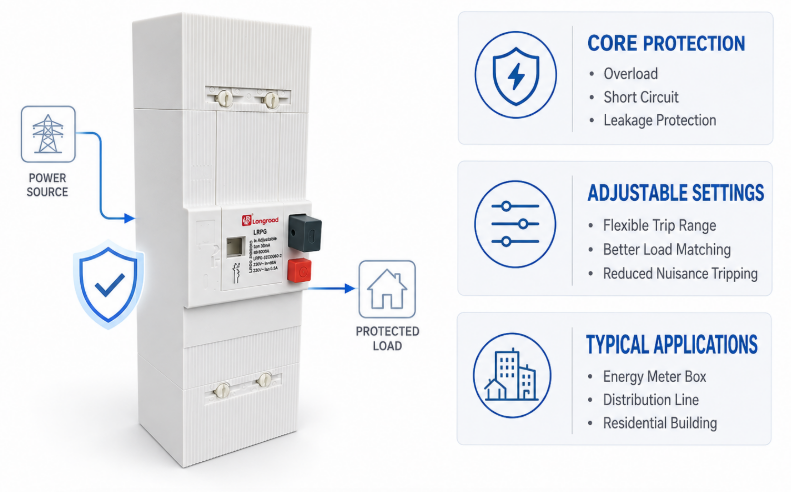
Adjustable current circuit breakers represent a significant technological upgrade over fixed units, providing users with the flexibility to fine-tune current thresholds and timing parameters to perfectly match the unique demands of their electrical circuits.
The primary limitation of traditional, fixed-trip circuit breakers is their inherent rigidity. These devices are manufactured with a set trip value, meaning they cannot adapt to changes in electrical load or the specific requirements of new equipment installations. In contrast, an adjustable current circuit breaker allows for field-configurable settings. This flexibility is invaluable in environments where the electrical demand may fluctuate seasonally or where the circuit needs to be optimized for specific equipment performance, such as startup loads in motor-driven systems.
The advantages of utilizing adjustable models include:
Precision Load Coordination: Enables the exact matching of the breaker trip setting to the specific rated load of the circuit, reducing the risk of nuisance tripping.
Future-Proofing Infrastructure: Allows for system upgrades or changes in usage without the need to physically replace the breaker hardware.
Improved Selectivity: Facilitates better coordination with other downstream protection devices, ensuring that faults are isolated locally rather than affecting entire distribution branches.
Operational Efficiency: Simplifies inventory management for facility managers, as a single adjustable unit can replace multiple types of fixed-rate breakers.
For those requiring high reliability in demanding environments, selecting a 2P French Adjustable Circuit Breaker for utility service connection provides the ability to customize settings to prevent common issues like premature tripping during brief power spikes. This precision management enhances system uptime and ensures that the protection level is always aligned with the current operational requirements, providing a superior level of control compared to standard equipment.
Applications in Energy Management
Adjustable circuit breakers are central to modern energy management, offering the precision required to support high-accuracy energy metering and distribution in both residential and light commercial building applications.
In modern building design, measuring energy consumption with high fidelity is as important as distributing power safely. As homeowners and managers look to optimize electricity use, the hardware at the distribution level must support this data collection. Adjustable breakers designed for energy metering provide a stable environment for these measurements by ensuring that electrical noise and load fluctuations do not skew the data. By providing consistent, clean power delivery, these devices ensure that meters receive accurate voltage and current information.
Residential energy metering systems often require specific 2P (two-pole) configurations to handle standard electrical distribution lines safely. These breakers are frequently used in:
Distribution Lines: Protecting the main lines that feed individual apartments or residential units from the utility service.
Energy Meter Boxes: Serving as the protective control point before or after the meter to ensure safe operation and monitoring.
Lighting and Appliance Circuits: Providing localized protection for high-value equipment that requires balanced and regulated current.
The trend toward smart grid integration also means that protection devices must now communicate or at least remain compatible with digital metering systems. By using highly stable, adjustable hardware, installers can ensure that their electrical distribution network remains in harmony with the sophisticated monitoring technology used to track consumption, ultimately leading to better energy efficiency and lower utility costs.
Selecting the Right Circuit Protection
Selecting the ideal circuit protection requires a thorough analysis of the specific current requirements, environmental conditions, and the load characteristics of the devices being protected to ensure long-term system stability.
Choosing the correct breaker is not merely about selecting a current rating; it involves understanding the trip curve. The trip curve defines the relationship between the magnitude of the fault and the time it takes for the breaker to trip. For sensitive electronic loads, a fast-acting curve might be required, whereas for motor-based loads that experience high inrush currents upon startup, a slightly delayed curve is necessary to avoid unnecessary shutdowns.
When evaluating your options, consider the following checklist:
Continuous Load Capacity: Calculate the total amperage of all devices that will operate simultaneously on the circuit.
Fault Current Rating: Ensure the breaker has the capacity to safely interrupt the maximum potential short-circuit current of your service.
Environmental Compatibility: Consider if the installation location requires specific temperature ratings, humidity resistance, or ingress protection.
Future Growth: Anticipate potential additions to the circuit, such as new appliances or expanded lighting, and select adjustable hardware that can accommodate these changes.
By systematically evaluating these factors, you can create an electrical environment that is both safe and highly performant. Utilizing reputable, high-quality components ensures that your system remains compliant with safety standards while providing the versatility needed for today's dynamic electrical landscape.
Summary
The integration of advanced circuit protection is a non-negotiable aspect of responsible electrical system management. From understanding the fundamental mechanics of fault interruption to embracing the flexibility offered by adjustable current circuit breakers, the goal remains the same: a stable, safe, and efficient power environment. By focusing on high-quality, configurable components—such as those designed for modern residential and utility service connections—property owners and facility managers can effectively mitigate risks and ensure that their electrical infrastructure supports their long-term operational needs.