- Home
-
-

How to Choose the Right 2 Pole Breaker for Your Electrical Needs
Views: 0 Author: Site Editor Publish Time: 2026-06-10 Origin: Site


To choose the right 2 pole breaker, you must accurately match the device's voltage and amperage ratings to your specific load requirements, ensure compatibility with your existing panel brand, and verify that the breaking capacity is sufficient for the potential fault current at your installation point.
Choosing the correct breaker involves more than just picking a product that fits the slot in your panel. It requires a detailed assessment of the total electrical load, the operating environment, and the specific functional requirements of the equipment being protected. By following a structured selection process, you can ensure long-term reliability and system safety.
In this guide, we will explore the foundational knowledge required to navigate the complexities of 2 pole breakers, discuss key technical considerations, and provide actionable advice to help you avoid common pitfalls during installation and maintenance.
Table of Contents
Section
Summary
Understanding the Basics
Defines 2 pole breakers, their structure, and their role in 240V systems.
Key Considerations
Outlines how to evaluate load, voltage, amperage, and environment.
Top Types
Explores performance features, including Adjustable Current Circuit Breakers.
Common Mistakes
Highlights risks like mismatching loads and improper environment assessment.
Installation and Maintenance
Provides a guide to safe mounting, connection, and upkeep practices.
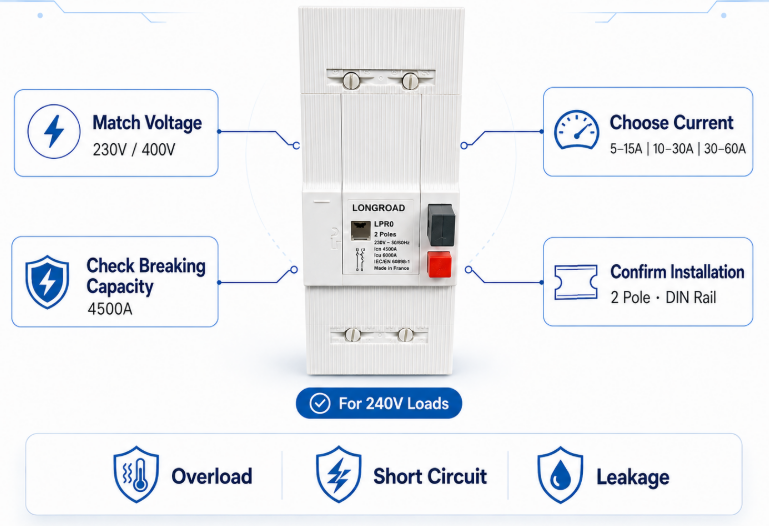
1. Understanding the Basics of 2 Pole Breakers and Their Applications
A 2 pole breaker is a specialized protective device that occupies two adjacent slots in an electrical panel and connects to two hot wires, enabling the supply of 240V to heavy-duty appliances while ensuring both legs of the circuit trip simultaneously during a fault.
These breakers are specifically designed to meet the demands of higher-voltage residential and commercial applications. Unlike a single-pole breaker, which handles 120V and connects to one hot bus bar, the 2-pole configuration connects to two separate hot bus bars. This design is crucial for balancing the load across both phases of a split-phase electrical system. When an overload or short circuit occurs, the tie bar or internal mechanism forces both poles to disconnect simultaneously, which is a vital safety feature for equipment that requires a full 240V supply to function.
In modern residential settings, 2 pole breakers are the standard for high-power devices that require consistent, stable voltage. Common applications include electric ranges, central air conditioning units, large water heaters, clothes dryers, and subpanels. By utilizing a 2 pole configuration, the system ensures that if one leg encounters an issue, the entire appliance is completely isolated from the power source, preventing damage caused by running an appliance on "single-phasing" or unbalanced voltage conditions.
Furthermore, these breakers often integrate with advanced electrical management systems. For example, modern high-performance 2 pole electrical protection units can be utilized not just for safety, but also to support energy monitoring, allowing homeowners and facility managers to gain better visibility into their power consumption patterns. Understanding these core functions is the first step toward building a robust and efficient electrical setup.
2. Key Considerations When Selecting a 2 Pole Breaker for Your Project
When selecting a 2 pole breaker, you must prioritize matching the amperage rating to the circuit load, ensuring the voltage rating is compatible with your supply, and evaluating the environment for factors like ambient temperature and humidity that could affect performance.
The process of selection starts with a precise calculation of the electrical load. You should consult the nameplate of the appliance or the NEC (National Electrical Code) guidelines to determine the required current rating. A breaker rated too low will experience frequent "nuisance tripping," while a breaker rated significantly higher than the wiring capacity poses a severe fire hazard because it will not trip before the wires overheat. Always match the breaker to the size of the copper or aluminum wire being used in the circuit.
Beyond amperage and voltage, consider the breaking capacity, often measured in kiloamperes (kA). This metric defines the maximum fault current the breaker can safely interrupt without failing or exploding. In residential applications, a standard 10kA rating is often sufficient, but for main service panels or industrial environments where the available fault current is higher, you may need a device with a higher kA rating. Always check your panel's short-circuit current rating (SCCR) to ensure your chosen breaker is appropriately matched to the system’s capacity.
Finally, do not underestimate the operating environment. If your electrical panel is located in a garage, basement, or outdoor enclosure, the ambient temperature can significantly impact the breaker's trip curve. Standard thermal-magnetic breakers are calibrated for specific temperatures (typically 40°C). In high-heat areas, you might need to "derate" the breaker or choose a model specifically designed for elevated temperatures to avoid random tripping during normal operation.
3. Top Types of 2 Pole Breakers: Performance and Features Explained
There are various types of 2 pole breakers available, ranging from standard thermal-magnetic models to sophisticated electronic devices, with the most advanced options featuring adjustable current settings and integrated energy monitoring.
The most common type is the standard thermal-magnetic breaker. These rely on a bimetallic strip to detect overloads (which take time to heat up) and an electromagnet to detect short circuits (which happen instantaneously). They are reliable, cost-effective, and ideal for standard household loads. However, for specialized industrial or high-efficiency residential systems, manufacturers have introduced more advanced technology to provide granular control over power distribution.
One of the most significant advancements is the Adjustable Current Circuit Breaker. Unlike fixed-trip breakers, these allow technicians to fine-tune the trip thresholds. This is particularly valuable for protecting motor circuits or equipment with high inrush currents, as it prevents nuisance tripping while maintaining tight protection against genuine faults. These devices are effectively "future-proof," allowing the protection parameters to be updated if the equipment load changes, without requiring the purchase and installation of a brand-new unit.
For a clearer overview of how these types compare, consider the following feature breakdown:
Standard Thermal-Magnetic: Fixed settings, best for general-purpose lighting and standard heating appliances.
GFCI (Ground Fault Circuit Interrupter): Essential for damp areas; detects micro-leaks in current to prevent electrocution.
AFCI (Arc Fault Circuit Interrupter): Designed to detect dangerous arcing conditions in wiring, significantly reducing the risk of electrical fires.
Adjustable Current/Electronic: Allows for precise tuning of long-time and short-time trip delays, ideal for industrial machinery and precision electronics.
4. Common Mistakes to Avoid When Choosing a 2 Pole Breaker
The most common mistakes when selecting a 2 pole breaker include matching only the amperage without considering the load type, ignoring the breaking capacity requirements, and mixing different brands within the same panel, which can lead to coordination failures.
One of the primary errors is focusing solely on the amperage rating while ignoring the specific nature of the load. For example, a motor load creates an "inrush current"—a momentary spike in power demand during startup—that is much higher than its running current. If you choose a standard, fast-acting breaker, it will trip every time the motor starts. You must use a breaker with the correct time-delay characteristics to accommodate these operational realities.
Another frequent oversight is the assumption that all breakers of the same amperage are interchangeable. This is rarely true. Breakers are designed to work within specific panel bus-bar configurations. Using an "equivalent" breaker from a different manufacturer can result in loose connections, which generate excess heat and pose a severe fire risk. Always stick to the manufacturer's recommended series, as they are engineered to provide the exact physical and electrical interface required for your panel.
Lastly, failing to consider the environmental impact on the breaker is a major mistake. Installing a standard breaker in a corrosive environment (such as near a swimming pool or in a coastal region) will cause the internal mechanisms to degrade rapidly. In these situations, you should opt for breakers with protective coatings or enclosures rated for NEMA 4 or better to ensure the device remains functional over its intended lifespan.
5. A User's Guide to Properly Installing and Maintaining Your 2 Pole Breaker
Proper installation and maintenance of a 2 pole breaker involve strictly following lockout/tagout procedures, ensuring all connections are torqued to the manufacturer’s exact specifications, and performing regular visual inspections to identify signs of heat or wear.
Before beginning any installation, the absolute priority is safety. Always de-energize the entire panel and use a calibrated voltage meter to verify that the power is off. Once the panel cover is removed, inspect the bus bar for any signs of pitting, blackening, or oxidation. These are indicators that previous connections may have been loose or that the bus bar has been damaged. A new breaker installed onto a compromised bus bar will fail prematurely.
When inserting the breaker, ensure it seats firmly onto the rail and bus bar. You should hear a distinct "click" when it engages. After snapping it into place, connect the load wires. It is critical to use a torque screwdriver to tighten the terminal screws to the value specified on the breaker label. Overtightening can crush the wires, while undertightening causes high-resistance connections that generate significant heat under load, eventually leading to a melt-down of the plastic housing.
Ongoing maintenance should involve bi-annual inspections. During these checks, look for discolored wire insulation, which suggests the wire is running too hot. Use an infrared thermal camera, if available, to scan for "hot spots" at the connection points while the system is under load. Regular testing of the breaker’s manual toggle switch ensures the internal mechanical trip mechanism is not seized. By keeping these components clean and properly torqued, you significantly extend the service life of your protection devices.
Summary
Choosing the right 2 pole breaker is an essential investment in the longevity and safety of your electrical system. By carefully evaluating your amperage and voltage needs, understanding the benefits of advanced options like adjustable current breakers, and avoiding common selection and installation errors, you can build a system that is both reliable and efficient. Always prioritize component compatibility and follow best practices for maintenance to ensure your infrastructure continues to perform optimally for years to come.