- Home
-
-

Beyond the Basics: Smart Circuit Breakers for Intelligent Protection
Views: 0 Author: Site Editor Publish Time: 2026-10-29 Origin: Site


Protection is the baseline for every circuit breaker. Intelligent protection begins when a facility can see a relevant state, make an approved decision, and act through a controlled process rather than waiting for an in-person check. A Smart MCB can support that approach by combining an appropriately selected miniature circuit breaker with model-specific communication and remote-management functions. It is important, however, to keep the word “intelligent” grounded: connected features can improve visibility and response, but they do not replace correct electrical design, qualified installation, or site safety controls.Key Takeaways
Intelligent protection combines appropriate electrical protection with clearer information, controlled action, and accountable follow-up.
A Smart MCB can be useful for distributed properties, scheduled non-critical loads, and managed response workflows.
Remote access must be limited by the load’s risk, the site’s procedures, and user permissions.
Device, network, app, and maintenance process need to be commissioned as one system.
From passive protection to managed protection
Traditional circuit protection has a clear role: interrupt fault conditions within the device’s specified operating limits and give a local operator a way to control the circuit. Intelligent protection does not remove that role. It adds a management layer that can help an authorized team understand what is happening at a particular distribution point and respond through a predefined rule.
For a property manager, that might mean confirming whether a vacant unit’s approved branch circuit is on or off before arranging a visit. For a facilities team, it might mean identifying a circuit that is operating outside its expected schedule. For an electrical contractor, it may mean delivering a clearer handover record and a controlled interface for a client’s selected platform. In each case, the benefit comes from an improved process, not from the connected device alone.
What a Smart MCB can contribute
A Smart MCB may offer a combination of local manual control, remote on/off commands, timed operation, state information, configurable functions, and communication with a gateway or platform. The available functions are always model-specific. The starting point is to decide which function the project genuinely needs and to verify it on the exact orderable product.
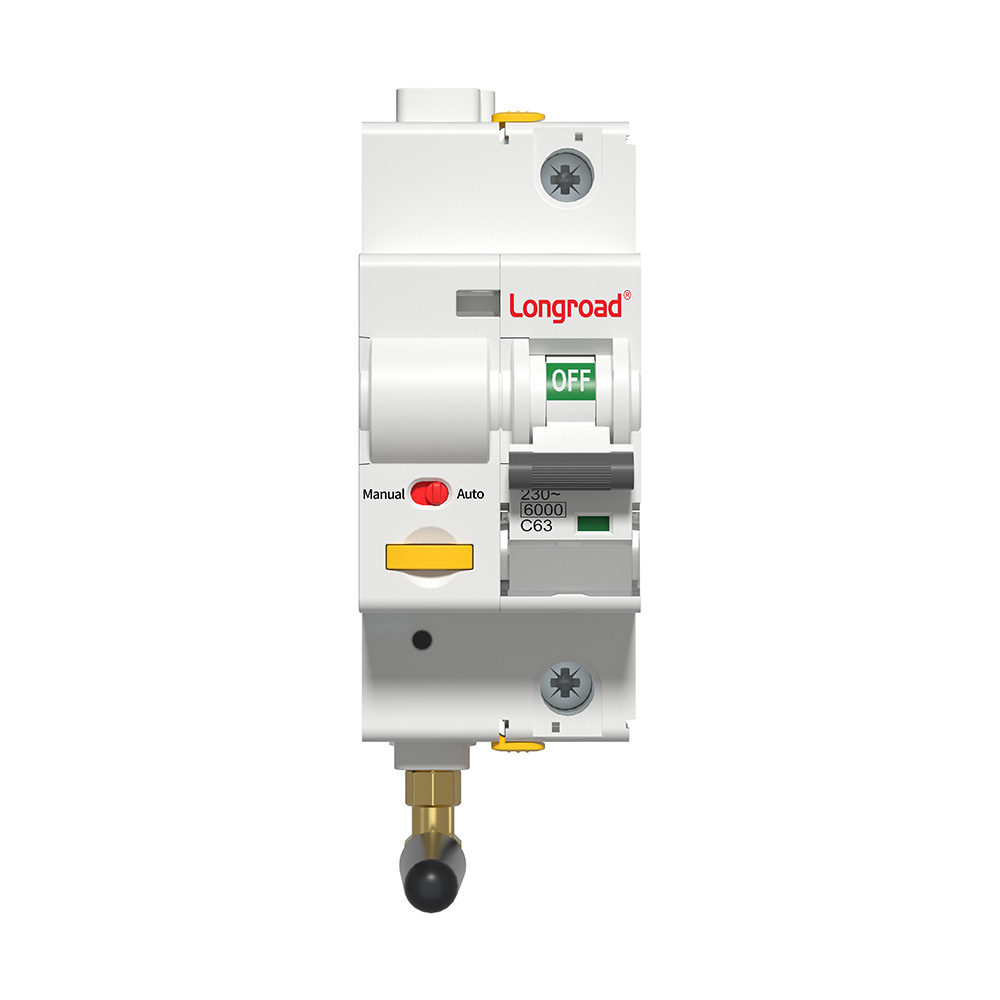
Long Road Electric describes its 1P Smart MCB WiFi for apartment rental management as an LRR6 device for residential and light-commercial power management, with remote switching, local manual/automatic mode selection, programmable timed on/off settings, and WiFi-based communication. Its product page lists 10A–63A options, 220/230VAC 50Hz, 6kA breaking capacity, and Type C/D curves. These published data points must be checked against the actual circuit, environment, and project documentation before selection.
Intelligent protection requires intelligent boundaries
Remote control is powerful precisely because it can change a circuit state without someone standing at the panel. That means every controlled point needs a boundary. Identify what the circuit serves, which conditions make remote operation unsafe, who may issue a command, when a local check is required, and how maintenance isolation overrides all app-level controls. Critical loads and circuits where people may be working need stricter controls or may not be candidates for remote switching at all.
Permission design matters as much as device installation. A property team may need to see status and request a change, while only an authorized electrical or facilities operator may execute it. Accounts should have owners, credentials should not be shared, former users should be removed, and any configuration change should have a traceable approval. These are ordinary operational disciplines, but they become essential when a circuit is connected.
Where Smart MCBs can make operations clearer
Scenario
Useful management objective
Boundary to establish
Apartment or rental portfolio
Check a known circuit state and manage approved vacancy or turnover procedures.
Tenant impact, emergency access, and authorized switching rules.
Shared building areas
Apply an approved schedule to predictable, non-critical loads.
Occupancy, security, and override requirements.
Distributed facility equipment
Confirm status before assigning a site visit.
Remote diagnosis is not a substitute for a safe physical inspection.
Building automation project
Expose a defined device function to a supported platform.
Protocol testing, failure behavior, and change control.
These are examples of decision frameworks, not automatic product applications. The correct circuit, device, and operating rules must be confirmed separately for every project. Intelligent protection becomes unreliable when it is used to generalize from a dashboard rather than to support a verified field procedure.
Designing a resilient connected workflow
Begin with the physical installation: correct device, correct panel location, verified terminals and torque, circuit label, and documented ratings. Then commission the communications: gateway or WiFi coverage, device identification, account ownership, and the intended control path. Finally, test the operations workflow: local action, status indication, authorized remote request, schedule behavior, loss of connection, restoration, and escalation.
Loss of communication deserves special attention. Teams should know what continues locally, which remote features become unavailable, how an operator recognizes the loss, and how recovery is checked. Do not rely on assumed cloud behavior or a generic tutorial. The exact product, app, gateway, and network determine the real behavior. A manual procedure should remain available for safe local operation and maintenance.
Choosing the right product family
The product category must follow the circuit. A single-pole connected device may be relevant to one type of branch circuit, while a two-pole option may be required where line and neutral are intended to be switched together. Long Road Electric’s MCB collection provides an internal starting point for comparing available miniature circuit breaker categories. Use the individual product page, current drawings, and project specification to confirm suitability.
It is also useful to distinguish AC smart-distribution devices from DC circuit-protection products. The LRM7-63DC 4P MCB DC1000V page describes a PV DC device for high-voltage photovoltaic applications. It is a separate application context; differences in DC interruption, voltage, topology, and standards must not be glossed over just because both products carry the MCB label.
Questions to ask before deploying at scale
Can the chosen device protect the actual circuit? Is there a realistic operating use for status, scheduling, or remote switching? Is the selected protocol reliable inside the panel and across the site? Who owns the app or platform account? What action follows an alarm? What happens during a communications failure? How will technicians lock out and maintain the circuit? Answers to these questions are more useful than a long list of features.
Long Road Electric can be evaluated where the LRR6 Smart MCB features align with a property or facility project. The sensible procurement path is to ask for the exact configuration and current technical documentation, then verify the electrical, communications, and operational fit through the project’s normal approval process.
Alerts should lead to decisions, not noise
An alert is valuable only when the recipient can understand it and has an agreed response. Before enabling notifications, define the difference between a routine state change, a communications problem, a protective event, and a condition needing an urgent site visit. Give each category an owner and a response path. An inbox full of poorly defined notifications teaches people to ignore the system, while a smaller number of well-governed alerts can improve response quality.
Test the entire notification path during commissioning. Confirm the correct device name, recipient, time zone, escalation behavior, and record of the event. Where a platform allows several users, avoid sending every notification to everyone. Route operational information to the person who can make the next safe decision, and review the rule when staffing or site use changes.
Security and ownership are operational requirements
Connected electrical equipment should be managed as part of the site’s digital estate. Use named accounts, least-privilege permissions, managed credentials, and a process for removing access when a contractor or employee leaves. Establish who owns the gateway, the app account, and any cloud subscription before handover. These decisions prevent an otherwise functional installation from becoming inaccessible or uncontrolled after a change of personnel.
Security also includes physical and procedural control. Keep panels appropriately secured, preserve local labels, and make sure maintenance personnel can identify the device and use the approved isolation process. A secure login does not protect someone working on a circuit if the control boundaries and lockout practices are unclear.
A practical rollout approach
For a multi-property or multi-panel program, begin with a limited, representative deployment. Select circuits with clear purposes and low operational ambiguity. Test the installation, naming convention, communications reliability, user permissions, alert handling, and handover materials. Then review what actually helped: fewer site visits, clearer triage, better schedule discipline, or simply more accurate circuit records. Use the findings to update the standard before expanding.
Scale only after the operating model is repeatable. A large number of connected devices without ownership creates more uncertainty, not more intelligence. The best rollout is the one that keeps the electrical design, the digital configuration, and the human response process in step.
What good handover looks like
A good handover leaves the next operator able to understand the circuit without guessing. It contains the panel and circuit reference, exact product identity, operating purpose, approved settings, relevant account ownership, supported communications path, local control method, remote-control restrictions, and escalation contacts. It also explains who may change a schedule or setting and how the change is recorded.
This record should be reviewed when the property changes use, a tenant installs different equipment, or the network and management platform are altered. Intelligent protection depends on keeping the digital configuration aligned with the real electrical installation; handover is the beginning of that discipline, not the final administrative task.
Review the system after normal operation begins
After a short period of real use, review whether the connected functions are improving decisions. Check for stale labels, excessive alerts, schedules that no longer match occupancy, unneeded permissions, and communications issues. This review is not a substitute for electrical maintenance; it is an operational check that keeps the smart layer accurate and useful. Correcting these small issues early helps prevent a connected system from becoming an ignored source of noise.
Design for local clarity as well as digital convenience
The site may need to operate safely even when a gateway, mobile device, or cloud service is unavailable. Keep physical panel labels legible, maintain the approved local operating instructions, and ensure that authorized personnel understand the manual path. Digital control is an enhancement to a well-run electrical installation, not its only means of control. This balance makes the connected system more resilient for both routine operation and maintenance.
Conclusion
Smart circuit breakers move beyond basic protection only when they make a real operating decision safer, clearer, or easier to carry out. A Smart MCB can add controlled visibility, scheduling, and remote response to an appropriate circuit, but it must remain part of a correctly designed distribution system. Define the circuit purpose, select the exact device for its electrical duty, establish who controls it, and test how the people, platform, and hardware behave together. That is intelligent protection in practical terms.
FAQs
What is intelligent protection in a Smart MCB system?
It is the combination of suitable circuit protection with defined information, controlled switching, and response procedures. It does not mean the device can replace qualified safety decisions.
Can a Smart MCB be used for apartment management?
It may be suitable where the exact product and circuit design support the application. The project must still define tenant-impact rules, user permissions, safe operating boundaries, and the local maintenance process.
Do remote commands work when WiFi is lost?
That depends on the model and system architecture. Verify the documented local and remote behavior for the exact device, gateway, and app before relying on it.
Can a Smart MCB automatically restore power after a trip?
Some products may list configurable auto-reclosing or related functions. Any automatic restoration needs a separate safety and application review because the connected load and fault cause matter.
What data does a Smart MCB provide?
Available status, measurement, logging, and alarm information differs by model. Review the exact technical documentation rather than assuming a connected breaker provides a particular data type or accuracy level.
Who should have access to the Smart MCB app?
Access should be limited to named users with responsibilities appropriate to their role. Separate view-only, request, and control permissions where the platform permits, and retain a documented account owner.